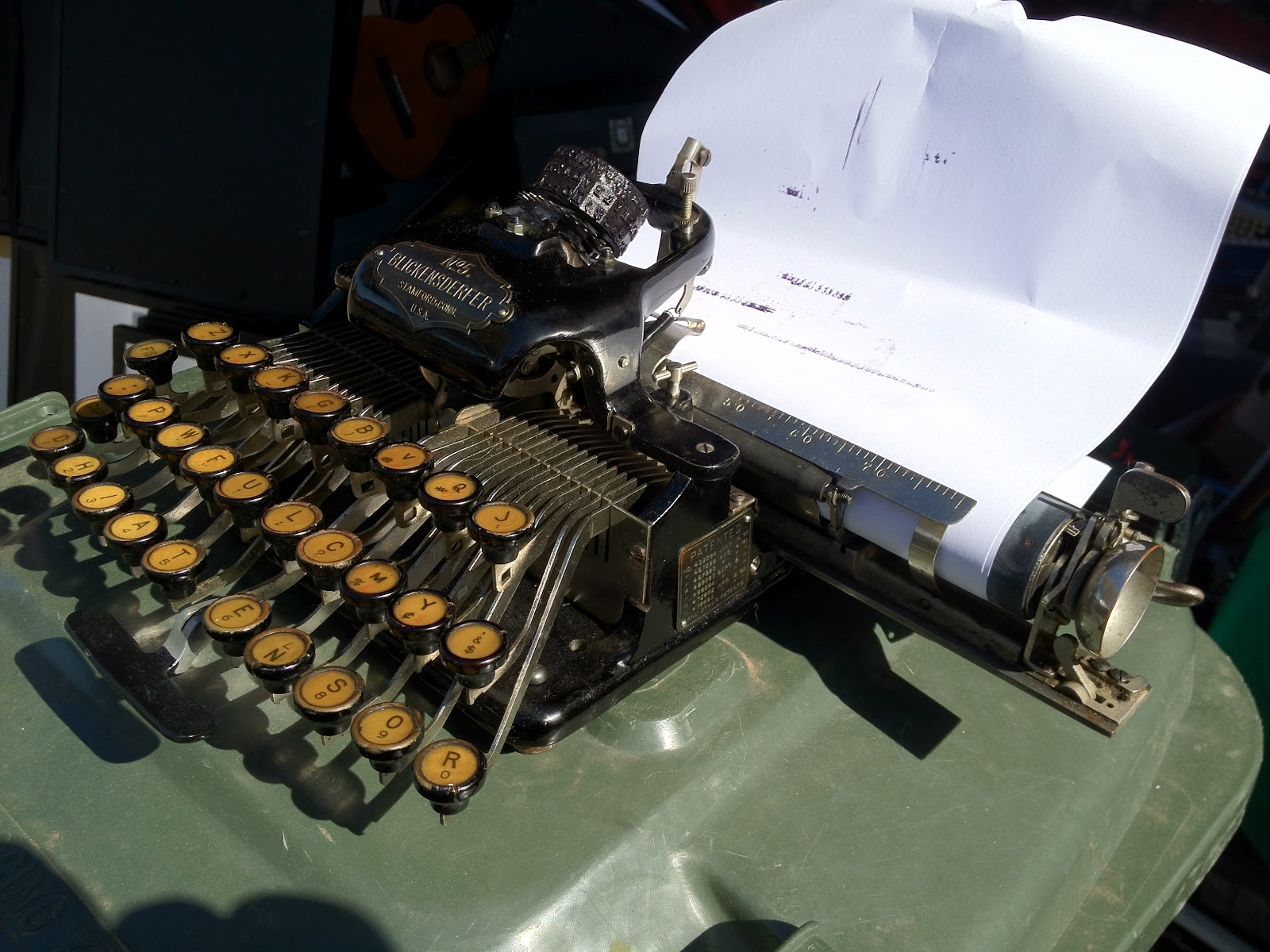
You know... I like typewriters, and I like to think I know a fair bit about them. But every so often I come across a machine that reminds me that, simply put, I don't know jack.

The mystery Baby in all its glory. Click to enlarge and have a good look at the keyboard.
I'm not in the business of collecting typewriters for the sake of unusual or unique variations of machines. I like typewriters for their beauty and their artistry. I like them for their functionality and form. I appreciate them for the history they bring with them, and I love them for the feeling I get when I write with one.
I didn't need another Hermes baby, but I saw this guy on eBay and I threw my hat in the ring simply because I noticed a couple of odd characters on the keyboard. Auction day came and no one else bid, and so it became mine for a wallet hurting $15. Not only was it cheap, but it was about a 5 minute drive from where I work to collect it.

As you can see by the screen grab above, the seller only photographed half the keyboard. The other photos were blurry, and the description simply read:
Antique Portable Typewriter and carry case.
Hermes Baby - typewriter.
I think this might have been used in a hospital in the 50's - there is in pen " Room 3" on the lid of the typewriter.
So I arrived at the seller's address at the appointed time, only to find that the seller was selling on behalf of the very much still alive owner of the machine - a quite senior and very lovely lady who was a former nurse. It appeared that her son was selling off a fair few of her possessions, or 'house clutter', and it was mostly piled up in the garage of the house - awaiting collection.
I had a brief discussion with the lady, but her son was getting quite impatient. He demonstrated his expert experience of typewriters by banging the keys and showing the carriage shifted - before telling me "Everything works on this typewriter as a typewriter should".
But I wanted to know more about the machine. Once I was able to get a full look at keyboard, I noticed that it was significantly different to any of the other typewriter keyboards I had seen before. On the right hand side of the typewriter there was a whole host of characters I found that were unusual.
"I bought it new when I was doing a business course before I became a nurse in the 60's" The lady explained "Its German made you know, and that's a German keyboard. It was made by Hermes - a very good company". She actually pronounced Hermes correctly too. The son argued a couple of points - insisting that it was the 50's. But she just looked confused about what he was saying, and tried to correct him that she bought it early to mid 60's. Also, it turned out that typewriter had never been near a hospital. I suspected the son was just obfuscating things to cover for the rather factually incorrect advertisement. Not that I cared about the advertisement, as I had long learned to disregard most of what a seller says on an eBay posting.
It most certainly wasn't a German keyboard, and I suggested this to the owner. I then muttered something about it being Swiss made, but she just nodded and said "That's a German keyboard".
The son shuffled about to display his impatience and suggest that the trade - and our business, was done. I was hoping to have a bit more of a chat, but it was obvious that this wasn't going to happen. So I just picked up my now paid for typewriter, said a gracious thank-you, and left.
The son shuffled about to display his impatience and suggest that the trade - and our business, was done. I was hoping to have a bit more of a chat, but it was obvious that this wasn't going to happen. So I just picked up my now paid for typewriter, said a gracious thank-you, and left.
I got the Baby home and then started to inspect the machine. Lo and behold, the (now former) owner was right. It WAS made in Germany.

I was a little stumped by this, but that was far from the last surprise for the afternoon. I had never heard of these machines being made in Germany before.
The typewriter wasn't made of plastic, but rather metal. This is the third Hermes Baby of this era I have come across, and the first that didn't appear to have been belted to a near pulp. This machine had been well used, but also quite looked after. I've found the metal on this version of the Hermes Baby to be the closest thing that you can find to play-doh, that is still a metal.
I also bet about half the readers that read this blog just silently nodded their head in agreement.
So - I cracked open the case to have a look at the serial number, and found 9006303, which oddly didn't tie into a number range that was covered on Ted's excellent Serial number Database.
The typewriter wasn't made of plastic, but rather metal. This is the third Hermes Baby of this era I have come across, and the first that didn't appear to have been belted to a near pulp. This machine had been well used, but also quite looked after. I've found the metal on this version of the Hermes Baby to be the closest thing that you can find to play-doh, that is still a metal.
I also bet about half the readers that read this blog just silently nodded their head in agreement.
So - I cracked open the case to have a look at the serial number, and found 9006303, which oddly didn't tie into a number range that was covered on Ted's excellent Serial number Database.
Okay... I thought. Let's just try typing with this machine.
And this is where it got weird. Not only did it have a better type feel than any other baby that I have ever owned or seen, but some other things seemed especially odd.
As you can see in the photo at the top of the page, the numbers are shift access only. But it isn't just the numbers. It's the full stop, and some other important characters as well. Then there was the ∘ character, which I just couldn't line up with any keyboard, character map or language alphabet at all.
I looked for currency symbols, only to find none. I was stumped.
I almost made a phone call to my friend Ray, who is a Linguist, when I stopped myself and just thought - "Rob Messenger will know, surely"!

Rob Messenger - Oztypewriter
It's a safe bet to ask Rob. He's got a vast head for a broad spectrum of details, and has been collecting for a lot longer than a lot of people i know. So I made Rob my first port of call. I'd been exchanging emails with Rob that afternoon over other matters, so I just dropped a mention of this machine into another email.
Amazingly, Rob got back to me within minutes. He wasn't absolutely certain, but he suggested that the machine had a "Brazilian 2" keyboard.
Coming from Rob, this was a suggestion that I was quite inclined to agree with. He'd gone through some reference material at a speed that would have to have been nothing but phenomenal, and had come up with what i knew would be an educated suggestion.
Rob also suggested that I have a chat with Georg Sommeregger, as he was much more extensively versed in the ways of the Hermes machines, and would know more about how a Hermes Baby come to be made in Germany - and possibly more on the keyboard.
Georg Sommeregger - Sommeregger's Sommelsuirum and Hermes Baby
Rob was right. As it was, Georg has a very strong knowledge on the German made Hermes baby. Georg told me a little about where the machine was made, and where it sat in relationship to the then existing Hermes factory (not very far at all, incidentally). And that he also lived in the same area.
It was quite fascinating. Georg also suggested that the machine was made in the earlier phase of Pailards manufacturing of the Baby in Germany, which would put the machine's manufacture around 1965. This was great news, as it matched up with the time-frame which the previous owner claimed to have bought the typewriter new.
So in my mind, the mysteries of the date and location of manufacture were solved.
Georg also made a suggestion about the keyboard. He sent me a scan of a character map for a Gossen Tippa - that showed the 'Italiano' layout of their keyboards. The layout was almost identical to the layout of my Hermes - except for two crucial differences. Firstly it didn't have an ∘ on the keyboard, but had a ∘ instead. Also, the Italiano keyboard layout was QZERTY, and not QWERTY.
The rest of the keyboard, including the shifted full-stop (period) matched perfectly.
I thanked Georg as he'd been a great help, and then messaged Rob with the findings - confident that Georg's suggestion of it being 'possibly a variation of the Italiano keyboard' was right. Rob however was a little more skeptical.
And this is where it got weird. Not only did it have a better type feel than any other baby that I have ever owned or seen, but some other things seemed especially odd.
As you can see in the photo at the top of the page, the numbers are shift access only. But it isn't just the numbers. It's the full stop, and some other important characters as well. Then there was the ∘ character, which I just couldn't line up with any keyboard, character map or language alphabet at all.
I looked for currency symbols, only to find none. I was stumped.
I almost made a phone call to my friend Ray, who is a Linguist, when I stopped myself and just thought - "Rob Messenger will know, surely"!

Just catching a few rays on the deck; trying to tan up that European paleness.
Rob Messenger - Oztypewriter
It's a safe bet to ask Rob. He's got a vast head for a broad spectrum of details, and has been collecting for a lot longer than a lot of people i know. So I made Rob my first port of call. I'd been exchanging emails with Rob that afternoon over other matters, so I just dropped a mention of this machine into another email.
Amazingly, Rob got back to me within minutes. He wasn't absolutely certain, but he suggested that the machine had a "Brazilian 2" keyboard.
Coming from Rob, this was a suggestion that I was quite inclined to agree with. He'd gone through some reference material at a speed that would have to have been nothing but phenomenal, and had come up with what i knew would be an educated suggestion.
Rob also suggested that I have a chat with Georg Sommeregger, as he was much more extensively versed in the ways of the Hermes machines, and would know more about how a Hermes Baby come to be made in Germany - and possibly more on the keyboard.
Georg Sommeregger - Sommeregger's Sommelsuirum and Hermes Baby
Rob was right. As it was, Georg has a very strong knowledge on the German made Hermes baby. Georg told me a little about where the machine was made, and where it sat in relationship to the then existing Hermes factory (not very far at all, incidentally). And that he also lived in the same area.
It was quite fascinating. Georg also suggested that the machine was made in the earlier phase of Pailards manufacturing of the Baby in Germany, which would put the machine's manufacture around 1965. This was great news, as it matched up with the time-frame which the previous owner claimed to have bought the typewriter new.
So in my mind, the mysteries of the date and location of manufacture were solved.
Georg also made a suggestion about the keyboard. He sent me a scan of a character map for a Gossen Tippa - that showed the 'Italiano' layout of their keyboards. The layout was almost identical to the layout of my Hermes - except for two crucial differences. Firstly it didn't have an ∘ on the keyboard, but had a ∘ instead. Also, the Italiano keyboard layout was QZERTY, and not QWERTY.
The rest of the keyboard, including the shifted full-stop (period) matched perfectly.
I thanked Georg as he'd been a great help, and then messaged Rob with the findings - confident that Georg's suggestion of it being 'possibly a variation of the Italiano keyboard' was right. Rob however was a little more skeptical.
Natalie Tan - NatsLapTaps
Meanwhile, I had been spit-balling a few ideas with a few people on facebook. Nat made an interesting suggestion about the ∘ key, and suggested that it was used to write N∘ - as it was a common abbreviation of 'Number'. My Cyrillic Hermes has a N∘ key for this specific purpose, so I was a little cynical of this idea. Nat also then suggested that the machine perhaps had been set up to write lots of numbers, and names in capital letters - hence why those important functions, including writing N∘, were all achievable with the keyboard caps locked.
Emigrant keyboards.
While talking to Georg, I wrote that I felt that the Italiano keyboard made a lot of sense - particularly as Australia had taken in a lot of post war refugees, and economic refugees. One of the largest groups represented in this mass migration to Australia - were the Italians. The Greeks followed soon after, and subsequently made Melbourne famous for having the largest Greek population outside of Greece.
A lot of these migrant groups formed communities in Australia, and it wasn't unusual to find their languages and customs being continued in various areas.
Anyone my age or older, can remember exactly what Lygon street in Melbourne used to be like - before it became a tourist attraction. And then there's Franco Cozzo - who crammed Italian, Greek and English into his television commercials in the 80's. Not to mention crammed his show-rooms full of truly ugly furniture (and somehow drugs, but that's another story).
Anyone my age or older, can remember exactly what Lygon street in Melbourne used to be like - before it became a tourist attraction. And then there's Franco Cozzo - who crammed Italian, Greek and English into his television commercials in the 80's. Not to mention crammed his show-rooms full of truly ugly furniture (and somehow drugs, but that's another story).
Oh, the Nostalgia!
Foot-as-cray! (sorry, local in-joke. Teeritz and John are likely to get it).
I could almost see the raised eyebrow in Georg's reply email. This time around, he sent me a couple of examples of a 'Lithuanian emigration' keyboard. The emigration keyboard layout he showed me went from the traditional AŠERTZ keyboard, to a QWERTZ layout (migrating to Germany perhaps?), while still retaining much of the character map and layout outside of the figurative characters.

The suggestion was that perhaps this machine of mine had been designed specifically for Italians that were migrating to Australia. However, there wasn't any concrete evidence to suggest that this machine could be such a machine.
No one seems to be certain about the nature of this keyboard and who it may have been made for. What also remains a mystery, is how this machine came to be owned by an Anglo-Australian nurse - who bought it new from the show-room. Natalie made a suggestion that a shop might have sold it at a discounted rate to her, which may have encouraged her to buy such a machine. But unfortunately I'm not in a position to easily check out this idea.
So there we have it! The mystery Baby. A machine that seems to have a blurred history that hints at an interesting story of humanity at almost every turn. Stories that seem sort of painfully just outside of my reach.
I like this little machine. If I'm going to use it, I know I'm going to struggle a bit with the shifted full-stop. And its story very much intrigues me. If you have any suggestions or ideas about this machine, please leave a comment below.
I also really appreciate the help I got from Rob, Georg and Natalie. Thanks guys!
I can't believe I seriously mentioned Franco Cozzo in a semi-serious way on my blog. Also, if this is indeed an Italiano keyboard, does this mean that the typewriter should be really called a "Hermes Bambino"?
I like this little machine. If I'm going to use it, I know I'm going to struggle a bit with the shifted full-stop. And its story very much intrigues me. If you have any suggestions or ideas about this machine, please leave a comment below.
I also really appreciate the help I got from Rob, Georg and Natalie. Thanks guys!
I can't believe I seriously mentioned Franco Cozzo in a semi-serious way on my blog. Also, if this is indeed an Italiano keyboard, does this mean that the typewriter should be really called a "Hermes Bambino"?