Showing posts with label collection. Show all posts

Friday, 28 February 2014

Appreciating typewriters.... a little too much?


Hi. My name is Scott, and I have a typewriter problem. 

Well.... Not a problem per-se. They've all been kept in cupboards and haven't obstructed hallways and bedrooms. I'm not climbing over typewriters to get into bed. 

That said, I have contemplated keeping one next to the bed so that I could bash off some writing ideas when I had a sudden urge. Like at 5 am this morning when I had an amazing dream, and then realised I could structure a plot around some of the images in my dream that would make a brilliant science fiction novel. 

But anyway..... 

As you can see, I have a lot of typewriters there. The pile to the left - the smaller pile, is the 'to sell' pile. The rest of them, well they are just too beautiful to part with. And I have a handful of standards and other machines that aren't in this shot, so the problem is slightly bigger than this. 

So while I feel these guys aren't in the way, and they are beautiful pieces of industrial art (and I write on them all) it doesn't appear that there's a real problem. 

That is, until I move house. 

Things are in a bit of a state of flux here at the moment, and the only certainty is that I'm going to be moving. Somewhere. It is either going to be interstate or overseas, but we're still waiting on long over-due decisions to be made.

While this collection is combatively minor by typewriter collecting standards, it is still a large enough collection that it will be difficult to move. Particularly as it is possible that it may all end up in storage for a prolonged period. 

Ironically this isn't the largest collection in this house. Miss Jane's yarn supply is larger, and her book collection positively dwarfs the space taken up by these machines. And let's not talk about her wardrobe. But the typewriter collection has the disadvantage of being both harder to store, harder to move, and heavier than all of the books and yarn (including my own books) combined. 

I'm currently cramming as much as I can into boxes, and I'm sadly doing all the packing by myself as Jane has already headed interstate. Packing your house is stressful at the best of times, and while I've got nil certainty at the moment as to what direction we will be moving, when we will be moving, and how we will be moving there, I'm finding my mood swinging back and forth as I have to make hundreds of complicated decisions while I have what I would call 'soft goals'. 

I've already thrown our nearly more than I've packed. I have nearly 5 cubic meters of e-waste sitting on my back deck, and about a hundred boxes (I've already packed 36, and I haven't even started on the yarn on the books). 

It is all doing my head in! 

Now. What the hell am I going to do about these typewriters. 

P.s. Jane would kill me if I had a typewriter next to the bed. We have banned televisions from our bedroom (I always have, so no real loss there) and I think such things would be very unwelcome. And besides, I have an iPad, and it does the job with a fair bit more silence. But I have thought about a Hermes featherlite / baby

Speaking of which..... Hello Sexy! 


Sunday, 17 November 2013

When is an Olympia SM1 not an Olympia SM1?

The title of this post isn't some cryptic riddle. There's no prize to be given away to the person that gets it right, and I won't be asking anyone to turn their Facebook profile photo into a giraffe.

Some of you may recall the Olympia SM1 that I purchased over at Woolloongabba antiques earlier this year that I promptly set about removing a layer of filth from its shell. Well, I dropped that typewriter to John Lavery who gave it a final fixing and fine-tuning for me (thank you very much John!) which subsequently led me to developing a short lived secret and financially unhealthy obsession with Olympia typewriters.


The SM 1, or as some like to call it - the Olympia SM, sort of feels like an unfinished re-design of the original Olympia Progress typewriter. However has bucket-loads of charm and style and is still a very appearing machine. 


Other than the oddly obvious screws on the side of the typewriter, the SM is quite a polished and distinctive machine. It is very well made, and is excellent to type on.

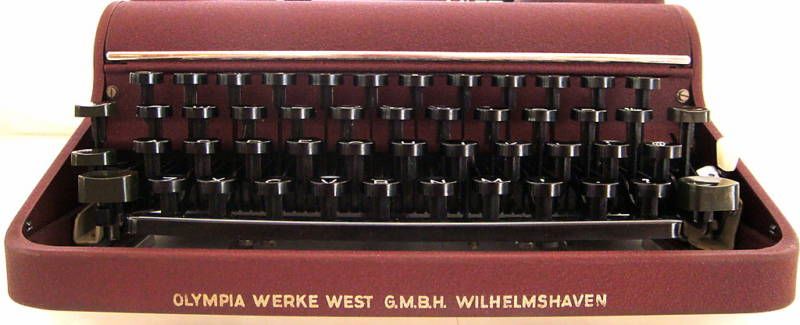
So surprised by the quality of the early Olympias, I soon found myself looking for other Olympias of more developed years on ebay. This was a short lived obsession that culminated in the purchase of a maroon machine that I spotted on German ebay.

I contacted Peter Muckermann and he kindly agreed to forward the machine onto me (danke Peter!). After a few weeks I had in my hands a gorgeous Olympia in the colour that Olympia does so well.


The typewriter unfortunately came loose in its case during transit. But as a testament to the quality of the construction of these typewriters, the machine sustained no damage other than a miss-placed escapement release bar. 

On the other hand, the clips the held the typewriter in the case were substantially bent, including the thick steel support rods located at the top of the case. These took some real effort to get back into place, and I can only conclude that the typewriter copped a hell of a knock in transit. 


But I was so pleased to have this beautiful typewriter in my possession that I really didn't worry too much about what had happened to it. Hey, it is usually nice to have something to fix.

But there was something strange about this typewriter. Something... didn't feel the same when I tried to type on it. While the paint was the same crinkle paint as my other SM, it was a very glossy crinkle paint that was quite different to my other machine that was Matte.

Over all, it just didn't.... feel.... the same typewriter. It didn't type worse, it just typed differently. It was a bit dirty, so I couldn't tell if it was faster or slower as yet but there was definitely something different about the keys.

I looked closer and discovered something that I wasn't expecting. Looking at the photos above I'm sure some keen eyed members of the typospherian will no doubt spot something a little bit different to the normal SM1 labelling. But if you didn't, here's a closer look.


As opposed to:

Photo: VintageTypewriterJewellery.com


Orbis? Who is this..... Orbis... 

The back of the typewriter was also quite revealing. Whereas the label on the back usually has the very familiar cursive 'Olympia' logo, this machine instead has 'Orbis' in its place. 


Other than the glossy crinkle paint, there were also some other substantially more significant differences between the machines. 

Firstly, the two typewriters have different platen knobs. The plastic on the maroon typewriter felt and looked different to the larger, but less well-made versions featured on my SM1. 


The Maroon typewriter has quite a different case, which is colour-matched to the machine. 


Also, the maroon version of this machine has a significantly different keyboard.


As you can see, they keys on the maroon machine are significantly thicker, and have a sharper edge around the ring. My original SM1 has keys that are identical to the older Progess/Simplex/Elite machines from prior to WW2.

The differences between the keys aren't cosmetic either. You may also be able to see that the metal tabs under the keys that slot perpendicularly to the type lever don't extend as far down as they do on the SM1. As it turns out the keys on the Maroon machine are a lot more complicated. They have several interlocking parts, and appear to facilitate the keys to spring, like what we are more familiar with on the SM3 and 4 machines. The keys themselves feel oddly weighted compared to the SM1.

Naturally my first response was to jam 'Orbis' into google to find out what on earth I had in my hands.

Unfortunately very little came up. And what did come up was a confusing mix of bit-parts. So I promptly hopped onto email and messaged the most knowledgable guy that I know, that probably isn't going to have a problem with me late-night work-fatigued lack of english language skills.

So I emailed Rob Messenger.

Rob didn't have a lot, but he had some interesting things to say about 'Orbis'. Between Rob and the other sources that I consulted, I eventually got a very vague picture about the history of this typewriter.

After WW2 the bulk of the Olympia design and engineering workers managed to have somehow gotten themselves over the border from East Germany and into the more business capital orientated West. Here they began to set up a new company to begin building typewriters again.

However, they appear to have faced a few barriers. Firstly, they had no money. They attempted to extract the capital that was related to the original Olympia interests in East Germany, but were reportedly thwarted at the last step. Secondly there was a tussle over who had the rights to use the 'Olympia' name. As such 'Orbis' was born. Orbis was a name that had been associated with the company before.

While the legal fight went on, the company started to produce typewriters. However the company must have seized control of the name early in manufacturing, and as such The machines ended up being badged 'Olympia'.

On the East German side Optima was formed, and they used existing designs to construct Olympia machines.

However the paper table gives away something about the history of the maroon machine. The 'Olympia' badge sits in an oddly recessed shape on the paper table, that looks like it is some kind of slot in plate. While I was doing some investigation into the 'Orbis', I found this photograph on Pinterest.

Photo: The Typewriter Workshop. 

This machine features the same carriage lever, keys, rubber feet and paper stand from the pre-WW2 machines, while it has the later crinkle paint, and at least 1 of the chrome strips. Note that the badge does not sit in a recessed section on the paper-table.

If you look at the typewriter database there is an Orbis model listed which was made for approximately a year - around 1949. This machine was reportedly over-engineered and significantly more costly than the prevailing SM1.

I don't have a lot of information about this era of machine, and a such it is open to conjecture about what machine is what. This becomes even more complicated when you discover 'Olympia  model Orbis' machines being advertised several years after the 1 year manufacturing period of the 'Orbis'.

From the 'Sydney Morning Herald' in March 1951. Similar ads featured in the newspaper until late 1952. The 'Royal Easter Show' is a large rural fair that occurs in Sydney every year. 

The machine in this photo appears - with a bit if eye-straining, to have the same platen knobs of the SM1, and the same keys. It is possible however that this is largely a over-stock line that was expensive and hard to sell in Sydney at the time before, they started selling SM labelled machines. But that is pure speculation. 


So, very little is clear about this maroon machine. But that doesn't detract from me enjoying it. Then again, I have suddenly found myself with a handful of Olympias, all of which are magnificent machines. 

But more about that later.... 

Saturday, 19 October 2013

I'd buy that for a dollar, or three.

I felt slightly jealous of some of the ultra-cheap typewriter finds that Ted and and a few other typewriter lovers recently posted about. Or at least until.... 

(pardon my sloppy english). 


The Adler.... It looks a little worn an beaten, but may prove to be an excellent typewriter yet. 

* * *

Oh, but it didn't end there... 


That's right. 12 typewriters. That makes them $3 each. The photos did not provide much in the way of information on these machines, as the seller had basically just crammed whatever he could into three photos without attempting to make any effort to display what he had. 

As such at least 4 of the typewriters were going to be a bit of a 'lucky dip' selection. But I did spot a very familiar case on one, that I was certain would make this worthwhile. 

The problem is, that my collection had already burst at the seams as it was. I just simply don't have storage space to put them. Suddenly adding another twelve to the mix is going to be interesting. 

The morning that the auction ended, I went over and collected the horde of machines and loaded them into Ruby the Exxy with the assistance of miss Jane. It was essentially a deceased estate, as these machines belonged to the seller's late father. 

"He was trying to fix them and sell them" the seller told me. "But I think he was asking too much for them or something". The seller was ex-army. He struck me as the kind of guy that would have been a 'plantie', an engineer that would operate or maintain heavy machinery used in construction. His car was adorned with army stickers, and the less tasteful  car 'breasticles', a variation of 'Truck testicles' that looked like breasts hanging from his tow-bar. 

Either way, the collective of machines were both filthy, and in disarray. A couple of the machines were flat-out just nasty, with wasp nests and rust giving the collection a texture that made one feel compelled to get a tetanus shot just for handling them. 

I had been emailing both John and Steve about these typewriters, and we'd agreed grab whatever we particularly wanted the most from the collection of machines. As I drove out from the seller's house, I called Steve and asked him if he would like to take a look. 

I laid out the collection on Steve's front lawn, and we were soon going over each machine with something of a cursory inspection. John had already expressed that he wanted the big Remington standard, and I wanted the particularly green coloured typewriter that I had spotted as just a case in the photos. 

More typewriters growing from Steve's lawn? 

No prizes for guessing which machine I gave my immediate preference to. 

As you can see, there's also a box of Adler branded ribbons. I have no idea as to what condition these are in, but I'm curious to find out. 

There was really only two machines that I at this stage feel are irretrievable. The rest of them I am certain can still have another life yet. But I may find some disasters await me when I start to have a much closer look. Either way, at $3 each typewriter, there's really nothing to cry about. 

The big Olivetti Studio even had its cover, and interestingly a list of songs that looked like it was for a country music christmas celebration. I immediately had the mental image of some RM Williams clad man with an Akubra hat on, tapping out the list of his favourites on that big ol' Olivetti. Trouble is that the machine's design had 'space age' written all over it, so far as it even had a 'techno' typeface. As such it just didn't seem to be the right typewriter for the part. Not to mention that a woman had signed off on the list with some christmas wishes. Not that women don't cruise around wearing RM's and big hats. 

Fragments of the past. Oh... hang on, there's some familiar names here.

Steve grabbed out of the collection an Olivetti 32, and a Underwood 310. I'm certain with a bit of a clean the 310 would come up looking quite beautiful with its striking cobalt blue ribbon cover and trim, and vibrant white shell. I think he's got a worthwhile machine there. 

We loaded the 10 other machines back into the car and Jane and I made our way home. I've now got 10 more typewriters that need assessing and, well, probably urgent attention, sitting in my shed. That's 11 typewriters in total this week from just the local countryside.

It must be fruit-pickin' season. 

Saturday, 19 January 2013

A mid summers day drive. John's collection.


I'd been driving for about an hour and a half. Just after I left my home I'd checked the outside temperature and discovered it was 30 Degrees C. (86F). But now, as I was passing Through the town of Beaudesert, it was reading 39C (102.2F). 15 minutes later when I was nearing my destination, it was reading at 41C (105.8F).

The Air conditioning in the Nissan was blasting on 'leaf-blower' mode, which was keeping the cabin reasonably cool. But the brown smoke haze from some near-by bushfire was a constant reminder that outside of the car, things were pretty damn hot.

This was old farm land we were passing through. Beaudesert is unmistakably a rural town, with many of the ubiquitous country 'Elders' business signs posted around the place, and lots of dealerships of farm machinery and associated farming products ling the highways. At the center of the city is a beautiful Art Deco pub, which I had helped install Air Conditioning into about 4 years ago.

There were some farms that looked green and productive. But largely the landscape appeared dry and and worn. I turned off the Mt Lindesay Highway about 10 minutes down the road from Beaudesert, and found myself on a battered and pitted piece of bitumen. Several sections of this road were brand-new and smooth, and were obviously sections that had been replaced after the originals were washed away or heavily damaged during the heavy flooding that covered Queensland two years ago.

I was on my way to meet a chap named John. He has moved up from Melbourne several months ago, and had tracked me down via this very blog. He had been Typewriter Mechanic once and has worked for some rather prominent names. Olympia, Olivetti, Remington. He has shared tales about his time at agencies like Chartres and McDougalls - names associated with some major trade in typewriters in Melbourne, and Australia.

John found me out online while looking for like minded typewriter eccentrics here in Brisbane. When I saw in his email that he was from Melbourne, been in that city for some time as a mechanic, who had also had run several typewriter businesses of his own - I realised that there we were likely to have a deal in common, more than just typewriters. He didn't know it when he first emailed, but not only was I from Melbourne, there was a pretty good chance the he'd worked with, and known my grandfather.

So while chatting to John on the phone, I segued into telling him. "Scottie Connell"! John exclaimed while searching his memory about him. Like all memories, people from the past don't always come to mind quickly, but he remembered the name - and it rolled off his tongue with genuine familiarity. 

I was now on my way to meet John and check out his collection. John told me that he'd acquired something like 400 or so machines. Unfortunately in the move to Queensland just recently, many of them had been damaged in transit when the shipping container that stored them had been dropped.

John, it turned out was a very friendly and energetic man. If it wasn't for the inevitable effects of age I'm certain he'd probably have stood the same height as me. But one thing that hadn't aged were his typewriter mechanic forearms. He had the kind of muscle that the teenagers these days seem to spend hundreds of hours in the gym trying to build up. I'd dare say that John was also far more charming than most of these teenage 'juicer' gym junkies too, and would probably have far more success 'pulling the chicks'.


I looked around for tins of Spinach he may have had hiding in his pockets.

John also has a very lovely wife by the name of Margaret, who was a delight to talk to. I'd brought Ms Jane along with me, as she loved these country drives - even if she had absolutely no interest in the old typewriters.


John had quite comfortably moved into his beautiful country home, and had set up a great workshop down stairs. Upstairs, the house was nice and cool from the Air-conditioning while downstairs the workshop quickly rose towards 45C (113F), and may be further, after we turned the lights on and started to excitedly pull machines out of the shelves to look at and compare notes.

John also had a surprise for me sitting on his workstation. But I'll tell you more about that in a moment.

In the workshop there was the obligatory workbench (which reminded me that I need a decent one of myself) and a typewriter workstation that was made for making working on his machines easy. It looked like a typing desk with a floating desktop that could be adjusted in height - I think, and it had a padded 'lazy Susan' - a swiveling table that allowed John to spin the machine around quickly.

The shelves were filled with machines that were largely in their cases still. Some of the standards were covered in foam, fabric, cardboard and tape to protect them. Other machines rested where they lay - all as long as they were out of the way.

I couldn't count them. There were everywhere, and stacked two deep on the shelves. I thought to myself, that it might not be a bad idea to get in with my DSLR and photograph and catalog these machines properly. If John was interested, that was.

It would be worth it, as just looking around the room I could see many familiar cases that belonged to quality brands and makes. Most of them were machines between the 30's and 60's. But there were some astonishingly beautiful older machines.

One of the first machines that grabbed my eye was a very ornate and intricate machine that had a name that obviously preempted my writing style by about 100 years. I grabbed my iPhone out and just took a few cursory photos.


The machine was, of course, a 'Typo'. It was a gorgeous down-strike machine with an interesting key lay out, along with many french characters.

Before long the machine was joined on John's bench by several other amazing machines that were catching my eye as looked through the machines that were the most easily accessed.

 This photo does no justice to this pre-war Olympia. It was a great machine with German characters.
While it looks SM1, the big 'P' on the front makes me wonder what model it actually is.

 Adler and Triumph machines! These were truly subtle yet stylish typewriters. 

A great looking bar-loc downstrike. Just beautiful. 

As we hunted and pecked through these machines, there were a couple of coloured cases that really stood out. Eagerly I asked John if I could get them down and have a look. One particular burgundy case really lit Johns eyes up, and he had an excited smile.

When we got the case down, we opened it up on a bookshelf and John exclaimed with pride "Look at that"! 

 A Groma Model T!

While the case was looking a bit battered and traveled, the machine inside was in astonishingly near original condition. There was a bit of dust on the machine, but I could tell that all it needed was a bit of a cloth wiped over it, and its 'to-die-for' looks would shine through.

I'd never seen a machine like it. Again, the photo doesn't do this machine justice. It was simply beautiful. The glass keys were clear, shiny and the kind of thing that keychoppers would go crazy for. The deep colour was just damn sexy - as were the curves of the shell. 

Not long afterwards I grabbed down another familiarly red toned machine. 

Any ideas? 

Now THAT is one seriously, seriously sexy Gossen Tippa. Hang on... what's that behind it?

It was now very hot. We started to make our way back up stairs, when we stopped and had a look at a couple more machines. One of these machines unfortunately wore the battle-scars of the big move up from Melbourne. It was a Mingnon machine that was in perfect condition. The machine just gleemed in the light coming through the window, and the metal didn't show anything of the pitted corrosion that often eats older machines ever so slowly. 

The case itself was perfect. Sort of. The top of the case unfortunately wore the scars of another typewriter punching down onto it with its feet. 

Beaten, but not out - the damaged Mingnon case.

There were two almost identical holes that had been crunched into the top of the plywood laminate, and it breaks your heart to see the damage. I can only guess how John felt about it - probably something alike how I felt when I dropped a 100+ year old wax cylinder recording onto a wooden floor some time back, shattering it into a powder. 

I could see that John was upset about it, and I really didn't have any solid suggestions as to how even a modest repair could be achieved. We put the machine away and went back upstairs, and out of the sweltering heat. 

John and I chatted for a while about a variety of machines, and exchanged stories. I had brought my blue Royal P for him to see, and also my dogged SG1 - which has to this date proven to be quite a challenge for me to repair. He gave me some good suggestions on repairing it, and I've got some work ahead of me yet.

The weather outside started to change, and the temperature began to drop. The sun was now heading down behind the mountains, and the clouds that had now gathered overhead looked as though they potentially would dump their rain on us at any second.

They didn't, but we headed home just the same. Ms Jane and I stopped in Jimboomba to get a bite to eat on the way, and as we walked into a famous resturant mega-chain, it was obvious we were back in the suburbs again. I walked past a couple of Juicers with big arms talking out front, and got a snippet of their blokey conversation. "It increased power by like 10%, cost about $30,000".

I thought to myself about how nice it is to have a conversation with mechanics, that didn't involve conversations of 'increasing power'. And I also realized that - really, typewriters are not only a more interesting hobby than just playing with the engine of a Commodore. And much cheaper.

*   *   *

I had come home with one my typewriter than I left with, and excitedly I dropped it onto my desk. If you recall, back when I visited Canberra, I was quite taken by Robert's Bing No.2. 

Well... guess what. 


John handed me this beautiful Bing machine. There's a catch though - it needs some challenging repair. The most significant issue is that the machine is missing its bearings. Currently the carriage is floating about mostly loose, and the bearings seem to be somewhere - over the rainbow.

I love the deco era machines the most, and I'm eager to get this machine operational again. I think I can! I think I can!

But seriously, I was stunned. And very thankful to John for this, and for letting me inspect - what was probably about, oh.... 5% of his collection. I'm looking forward to catching up with John again in the future. Typewriter people! They're great.