Showing posts with label Olympia. Show all posts

Monday, 28 April 2014

Surprises? I like surprises....

So... I'm back in Brisbane. 

I've been back a few days, and while this isn't a bad thing I'm feeling a little sad about it. Quite sad. 

But not too sad. There seems to have been a steady flow of little surprises of late. 

The Typewriters. 

Let's get down to business. Firstly, I managed to score a beautiful little Remington portable 2 that needs a little bit of mechanical attention, but will be a gorgeous little machine once I've got it going again. The colour was a surprise. Not only was it different to the photo on ebay, but I've never seen a Remington machine... ever... of this colour. However, it does have all the original Remington decals, and is suitably worn so I'm supremely confident that this is the original colour. 


I'm really excited about the potential of this machine. With a clean and a bit of hard work, I think it will be brilliant. 

Following hot on the heels of the Remington, is a machine that I've been excitedly waiting for, for some time. It has travelled a LONG way, and is a cracker of a machine - even if it is more modern then the machines I usually like. I have never seen one of those in Australia, or for that matter in the USA. It is the direct decedent of the Triumph Perfekt, and is a far more interesting machine in person than it is in the photos. 

May I present.... The Gabrielle - E 


better photos an a full review to come soon. 

Oh, and thanks a heap, Spider! 

To top it all off, a third machine came into my possession in the last couple of days. This one is a little more mundane, but there's something a bit special that came with it. 


It is an Olympia SM9, which there's got to be about a billion of these guys out there. Sure, it is far from rare. But it has only had one owner (now, I'm it's second) since the day it was bought. As you can see, the original receipt is there along with everything else. The lady that owned it kept everything meticulously organised. 


So we have the manual, a touch-typing guide that was produced by the Australian government's bank - the then 'Commonwealth banking corporation'. A test sheet that shows the typewriter's typeface is all in order, and there's the SM9 quick setup guide. 

But the receipt told a little story of it's own. This machine was bought somewhere very interesting. 


See which shop it was sold at, for $115, in 1971? 

That's Madang, Papua New Guinea. 


PNG was in a state of flux in 1971. It was a country that was coming back from being a major theatre of war during the second world war, and was forming its own government. Australia's own government assisted in the building of the nation, and we sent hundreds of bureaucrats to assist. Not only that, but hundreds of missionaries poured into the country to lay claim to the souls of thousands of tribal people that were still to have contact with the outside world. 

And here we have a then brand-new Olympia SM9 being sold to someone out of a shop in a fairly remote town in PNG. 

Parer's war. 

Speaking of PNG. Rob Messenger mentioned on his blog a couple of weeks ago a film that was going to be aired on Australian television called 'Parer's war'. I was rather eager to watch it, so I settled down with a cold drink and sat back and watched - with a bit of an eye out for typewriters that may pop up. Why not do a bit of typewriter spotting, you may say! 

But some of the interior shots of Parer's home seemed oddly familiar. And towards the end of the film I got an unexpected shock. 

The outside of 'Parer's' block of flats (apartments). 

Such a beautiful art deco building it is, right? 

The courtyard in the front of the building. 

That's also quite a beautiful court-yard. I wish I lived somewhere like that. 

Oh wait.... I did. Actually, when I started writing this blog in 2012 I was still living there. Remember my blog entry on the cinema nights I used to run in that courtyard? 

'Cinema Elron' 


Yeah... That Elron Court. 


The interior shots weren't filmed in Jane and I's old flat, but rather the flat that was opposite us across the garden at Unit 1. 


A good friend of mine used to live in that apartment, and I'd have to have spent hundreds of hours there drinking lovely wine and talking politics, religion and sex. All the stuff you don't talk about in polite company. 


Heck, when she was away I would go over and feed her birds, which were kept in the room that in this scene is being done up for a baby's nursery. Even the phone jack on the wall where her computer used to be connected is visible in this scene. 

Lovely! 

I did a fair amount of research into the history of the building when I lived there for 5 years (Jane lived there 11). It was built in 1939, and opened for tenants in 1940. 


But I have no idea if Parer himself actually lived there at any stage. There are a lot of interesting stories to be told about that place, and it was nice to have added history of my own to it's tale. 

Ahhhhh.... I'm getting all nostalgic again. I better get back to packing house, as I'm moving again very soon. 

Thanks for reading! 

Sunday, 17 November 2013

When is an Olympia SM1 not an Olympia SM1?

The title of this post isn't some cryptic riddle. There's no prize to be given away to the person that gets it right, and I won't be asking anyone to turn their Facebook profile photo into a giraffe.

Some of you may recall the Olympia SM1 that I purchased over at Woolloongabba antiques earlier this year that I promptly set about removing a layer of filth from its shell. Well, I dropped that typewriter to John Lavery who gave it a final fixing and fine-tuning for me (thank you very much John!) which subsequently led me to developing a short lived secret and financially unhealthy obsession with Olympia typewriters.


The SM 1, or as some like to call it - the Olympia SM, sort of feels like an unfinished re-design of the original Olympia Progress typewriter. However has bucket-loads of charm and style and is still a very appearing machine. 


Other than the oddly obvious screws on the side of the typewriter, the SM is quite a polished and distinctive machine. It is very well made, and is excellent to type on.

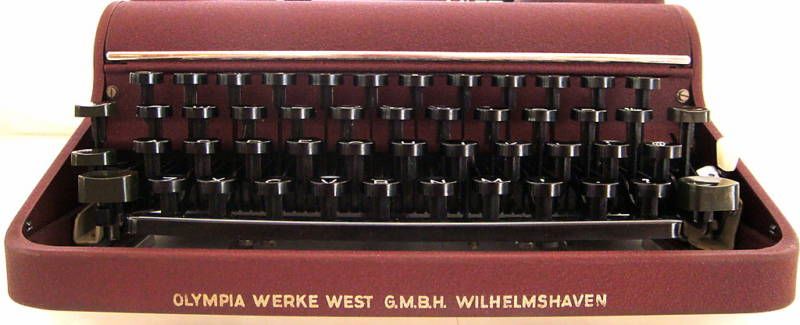
So surprised by the quality of the early Olympias, I soon found myself looking for other Olympias of more developed years on ebay. This was a short lived obsession that culminated in the purchase of a maroon machine that I spotted on German ebay.

I contacted Peter Muckermann and he kindly agreed to forward the machine onto me (danke Peter!). After a few weeks I had in my hands a gorgeous Olympia in the colour that Olympia does so well.


The typewriter unfortunately came loose in its case during transit. But as a testament to the quality of the construction of these typewriters, the machine sustained no damage other than a miss-placed escapement release bar. 

On the other hand, the clips the held the typewriter in the case were substantially bent, including the thick steel support rods located at the top of the case. These took some real effort to get back into place, and I can only conclude that the typewriter copped a hell of a knock in transit. 


But I was so pleased to have this beautiful typewriter in my possession that I really didn't worry too much about what had happened to it. Hey, it is usually nice to have something to fix.

But there was something strange about this typewriter. Something... didn't feel the same when I tried to type on it. While the paint was the same crinkle paint as my other SM, it was a very glossy crinkle paint that was quite different to my other machine that was Matte.

Over all, it just didn't.... feel.... the same typewriter. It didn't type worse, it just typed differently. It was a bit dirty, so I couldn't tell if it was faster or slower as yet but there was definitely something different about the keys.

I looked closer and discovered something that I wasn't expecting. Looking at the photos above I'm sure some keen eyed members of the typospherian will no doubt spot something a little bit different to the normal SM1 labelling. But if you didn't, here's a closer look.


As opposed to:

Photo: VintageTypewriterJewellery.com


Orbis? Who is this..... Orbis... 

The back of the typewriter was also quite revealing. Whereas the label on the back usually has the very familiar cursive 'Olympia' logo, this machine instead has 'Orbis' in its place. 


Other than the glossy crinkle paint, there were also some other substantially more significant differences between the machines. 

Firstly, the two typewriters have different platen knobs. The plastic on the maroon typewriter felt and looked different to the larger, but less well-made versions featured on my SM1. 


The Maroon typewriter has quite a different case, which is colour-matched to the machine. 


Also, the maroon version of this machine has a significantly different keyboard.


As you can see, they keys on the maroon machine are significantly thicker, and have a sharper edge around the ring. My original SM1 has keys that are identical to the older Progess/Simplex/Elite machines from prior to WW2.

The differences between the keys aren't cosmetic either. You may also be able to see that the metal tabs under the keys that slot perpendicularly to the type lever don't extend as far down as they do on the SM1. As it turns out the keys on the Maroon machine are a lot more complicated. They have several interlocking parts, and appear to facilitate the keys to spring, like what we are more familiar with on the SM3 and 4 machines. The keys themselves feel oddly weighted compared to the SM1.

Naturally my first response was to jam 'Orbis' into google to find out what on earth I had in my hands.

Unfortunately very little came up. And what did come up was a confusing mix of bit-parts. So I promptly hopped onto email and messaged the most knowledgable guy that I know, that probably isn't going to have a problem with me late-night work-fatigued lack of english language skills.

So I emailed Rob Messenger.

Rob didn't have a lot, but he had some interesting things to say about 'Orbis'. Between Rob and the other sources that I consulted, I eventually got a very vague picture about the history of this typewriter.

After WW2 the bulk of the Olympia design and engineering workers managed to have somehow gotten themselves over the border from East Germany and into the more business capital orientated West. Here they began to set up a new company to begin building typewriters again.

However, they appear to have faced a few barriers. Firstly, they had no money. They attempted to extract the capital that was related to the original Olympia interests in East Germany, but were reportedly thwarted at the last step. Secondly there was a tussle over who had the rights to use the 'Olympia' name. As such 'Orbis' was born. Orbis was a name that had been associated with the company before.

While the legal fight went on, the company started to produce typewriters. However the company must have seized control of the name early in manufacturing, and as such The machines ended up being badged 'Olympia'.

On the East German side Optima was formed, and they used existing designs to construct Olympia machines.

However the paper table gives away something about the history of the maroon machine. The 'Olympia' badge sits in an oddly recessed shape on the paper table, that looks like it is some kind of slot in plate. While I was doing some investigation into the 'Orbis', I found this photograph on Pinterest.

Photo: The Typewriter Workshop. 

This machine features the same carriage lever, keys, rubber feet and paper stand from the pre-WW2 machines, while it has the later crinkle paint, and at least 1 of the chrome strips. Note that the badge does not sit in a recessed section on the paper-table.

If you look at the typewriter database there is an Orbis model listed which was made for approximately a year - around 1949. This machine was reportedly over-engineered and significantly more costly than the prevailing SM1.

I don't have a lot of information about this era of machine, and a such it is open to conjecture about what machine is what. This becomes even more complicated when you discover 'Olympia  model Orbis' machines being advertised several years after the 1 year manufacturing period of the 'Orbis'.

From the 'Sydney Morning Herald' in March 1951. Similar ads featured in the newspaper until late 1952. The 'Royal Easter Show' is a large rural fair that occurs in Sydney every year. 

The machine in this photo appears - with a bit if eye-straining, to have the same platen knobs of the SM1, and the same keys. It is possible however that this is largely a over-stock line that was expensive and hard to sell in Sydney at the time before, they started selling SM labelled machines. But that is pure speculation. 


So, very little is clear about this maroon machine. But that doesn't detract from me enjoying it. Then again, I have suddenly found myself with a handful of Olympias, all of which are magnificent machines. 

But more about that later.... 

Thursday, 7 November 2013

So, tell me about this Carina 2 typewriter.


The Carina 2 is a very solid typewriter despite the plastic case, but is very light despite its size. Even when it is being kept in its interesting case. 


Sunday, 23 June 2013

Happy Typewriter Day! (internationally)


This lasted two minutes, before I put a towel down, stripped the machine's shell off and tackled the muck properly. 

The end result was worth it:
 

Our DSL modem and router packed it in sometime on Friday, and I was largely on a digital detox of my own for the weekend - the exception being that I still had net on my iPhone. Maybe I should just accidentally drop that next time.

Come Sunday afternoon I had blissfully enjoyed a lot of quality time with my new SM1. But more on that story later. The other 3 people in this house of 4 were rather desperate to get their 'net back. So, off we went to Officeworks, and got a brand-spanking-new DSL+ router, for more than I have spent on all but 1 of my typewriters. And going by our history with electronics here, it will probably fry and die in two years. Compare that to the longevity of this SM1.

I got some good writing done today too, after I had to make a pretty major repair to the SM1 which was sadly unexpected. It still needs some work on the escapement (it often jams after I release the carriage shift) but can I say... such a beautiful machine! Have you ever seen one like it? And there still was some ink in the ribbon!

Happy Typewriter Day! Love your typewriter, and it will love you.