Wednesday, 24 July 2013

The box.


About a month ago Ms Jane and I popped by her mother's house after we both finished work. Joy (her mother's name) had called and said that her partner, Andrew, had something that he wanted to give me that would need a bit of explaining.

Andrew had previously worked for a little company called 'IBM'. You may have heard of it. He was a call-out serviceman. 

It was during this period of Andrew's working life that he and Joy first met and forged a friendship that has lasted several decades. In the most recent couple of years they have grown quite close to each other, and now have a strong relationship. 

We arrived a Joy's place at about the time that most civil people would have been doing the dishes after dinner. My work clothes smelled of hospital, and I'm sure my face looked like it had been sprayed with Domestos. I was tired.

Joy was just settling in for the evening in her slippers and comfortable clothes, but Andrew had only recently gotten home from work himself and was quite bright and chirpy. Actually, he seemed quite excited.

We talked a little about the kind of day we'd all had, and then Andrew disappeard out the back door of the house, and downstairs to a cupboard under the house. He returned with a dusty old box that had originally carried canned fruit sometime in the 80's, but now hosted a collection of much more interest.

When Andrew began working at IBM, their biggest product was the Selectric II/III typewriters. They also were in the process of rolling out their wheelwriters, and variable type wheelwriters. While I sat there, both Andrew and Joy fondly spoke about these variable type machines, and the typewriters of their era. Andrew himself had a few interesting stories to tell  of his days of servicing these machines. 

Andrew settled into a glass of red wine, and started to tell me about what all of the parts inside the box where. As we talked, he would often excitedly go off on another tangent with stories of his work life with IBM, and it was a fascinating and interesting conversation.


Inside of the box were parts and tools from when IBM's typewriters were king. There were ribbons (likely dried out now) tools, cleaning swabs, parts and even a parts guide. And to my amazement, these weren't just parts stripped from a broken down machine. These were new and unused parts.

IBM selectric III 'Golf ball', still in original retail plastic.

Not 'just' any parts. But this collection of components covered some quite crucial pieces - including complete shaft assemblies for several different types of machines, and more importantly - a complete IBM  'Through-kit'; a kit that contained commonly replaced parts, that you would just automatically use to refurbish a machine.
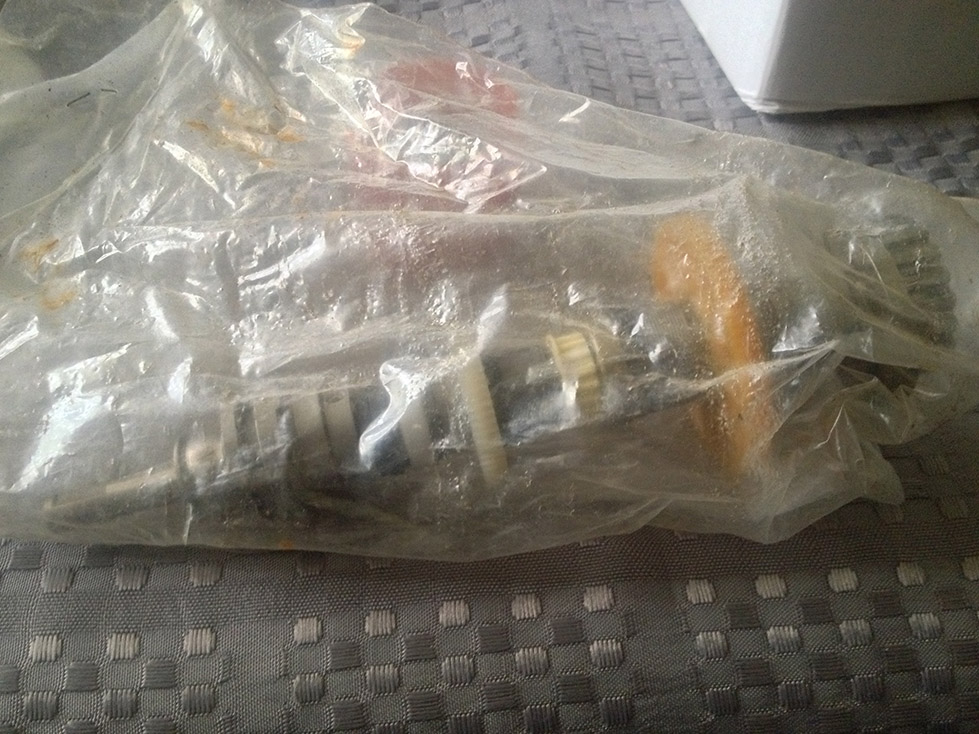
 A complete and unused shaft, still in its plastic.

Part of the 'through-kit', with a few extras thrown in. 

Andrew suggested that I could use these parts to trade and swap for parts with other typewriter enthusiasts. He knew that I had a couple of Selectrics, and knew that the variable type wheelwriters are rather hard to find in Australia.

But I had other ideas. The implications of such a collective of parts to me were huge. Sure, I could just swap these and have a couple of machines going. But then again, these were unused and unground parts. In the hands of someone with enough engineering knowledge and CADD skill, along with the right tools, this was a nearly priceless collection of reference parts. Parts that could be reversed engineered, modeled digitally, and potentially used to produce many more parts via the more modern 3D printing and prototyping technology that is available today.

Because these parts are unworn, they present the possibility of being able to take far more accurate measurements that could produce better end products. It will take a lot of hard work though. 

Ms Jane replaced the old box with a new one the moment we got home, as the old box barely survived the trip in the car without spilling its contents everywhere.

While we were at Joy's house, Joy decided to bring out hew own typewriter to show me. It was a marvelous Imperial Model 6, which has sat in her cupboard for several decades quite neglected. 


The metallic blue/green of the machine was actually quite eye-catching, and in person quite attractive. The machine has quite a collective of daily use muck in it, and a bit of plasticizer seepage on two keys. 

With a bit of work, I think this Imperial beauty has real potential to come up looking near new, and I look forward to taking the time to service and clean up a machine that means something to a family member.

There is also something of a family story attached to this machine. Joy has owned this typewriter since it was bought new for her by her Aunty, and has probably typed all kinds of wonderful things over the years. 

I think it is a thing of beauty, and it's great that she's kept it. 

I'm really excited about the box of parts, and it was great to talk to Joy and Andrew about their stories of using and fixing these typewriters. 

Thanks guys! 

Saturday, 13 July 2013

A big week for the typosphere, and no one knew anything about it!


I'm quite a fan of the scientific inquiry, and all the more if you can add artistry to it.

Earlier today I was sifting through my usual pile of emails. Ms Jane, who is a voracious reader had sent me a handful of typewriter related articles that she had stumbled across while surfing the world's news sites. She'd been pouring over the goings-on in the world while I was attempting a much more mundane task - the repair of a lawn mower.

With the lawn mower steadfast refusing to be revived with my half educated tinkering, I gave up and sat down to have a cold drink. I flipped open my iPad, and just browsed through the most recent of 1357 unread emails that Google keeps telling me that I have to pay attention to at - some point.

I clicked a link, and there before my eyes was a familiar name and a somewhat familiar face. It was journalist and writer - Robert Neuwirth. A man that is even sexier than me in a lab-coat, and gives me hope that I may still have a chance to look good when all my head hair eventually decides to completely abandon ship. 

Even though Robert doesn't have a typewriter specific blog, deep down he's one of us typospherians. If you have any doubt about this, you'll know otherwise by about 3/4ths of the way through the article.

The article can be found here.

The name should sound familiar to you too. Robert helped me find an Apothecary typewriter a little while ago, and quite often posts on the Portable typewriter forum. He also occasionally posts on a few of our blogs, but you may have missed it as he doesn't draw a lot of attention to himself by pasting his name all over the place.

I'm yet to finish reading Robert's first book, and I have it set aside at work for times when I need something to read while I'm waiting outside Labs and clinics, or stuck 'specialing' a patient.

Oh yeah, Google Robert's TED talks. They're worth a look at. Or at least I thought so. I just need to finish his first book, before I work on his second book that is full of material related to his TED discussion.

Robert, the 'Filthy Labs' team (which incidentally is just a team of one - me) dips our hat to you.

*   *   *

Speaking of good-guys, here's an article about how a patent lawyer saved the original paper patent work for a 'Type-writing machine' - a piece of history that was scanned into a computer, and then came within a whisker of being shredded and lost forever.

It appears that the US patent office is more than happy to simply destroy the mountain of industrial artwork that they currently find extremely expensive to keep. So, they have computerized their entire catalog and then set about recycling the originals. Many of which are historically significant documents. It appears that no one ever thought to offer any of them to Libraries, Museums or even collectors first.

Here's the article.  CAUTION: Contains historical bastardy.

Some of these pieces of art are potentially 'da Vinci-esque' works with their value to history potentially as yet to be realized. 

*  *  *

The end of Project FP. 

Project FP was my first big overhaul of a typewriter. I had huge plans for this magnificent beast, much of which will now go unrealized. 


When I received this heavy-weight from an eccentric seller over at Deception bay, it was a dreary battleship grey. Or as far as I could tell with the paint that wasn't scratched off, or heavily stained. Every key was frozen solid, and the carriage was glued in place - literally. The platen had glue that had been trickled all over it that had made its way into the machine.

Once I had the mechanical side of it moving again, I painted part of it a royal purple - and shifted the grey of the body up a shade to give it a brighter outlook. I also fed a purple ribbon into it. 

But then it simply ended up on the shelf. The great plans I had for this machine included copper plating key components, and then using the copper motif to decorate other embellishments. But it simply was too heavy to keep working on - especially when a particularly challenging repair, in the form of an Olympia SG1, was starting to take up any time that I had devoted to working on a heavy desktop machine. 


I was running out of room and interest when Rino of  'the Long slow {typecast} blog' mentioned that he would love to get his hands on a big desktop Royal. At the time Rino was bidding on a beautiful KMM that had appeared on ebay, which eventually went for a price that neither of us would have ever rationally justified. So after that loss I offered him the typewriter that I had personally named 'The Purple Smartie'. 

Rino came and grabbed it last Sunday, and I believe has been ironing out of few of the minor mechanical flaws that I had overlooked since then. It actually is a brilliant machine and I really did love typing on it. It was like firing a machine-gun that had been bolted to a block of concrete. Every letter was slammed onto the page with absolute certainty and speed, and the machine held its footing with steadfast determination that I had never seen before. 

Ryan Adney of 'Magic Margin' fame may be pleased to know that this isn't going to be my last attempt at repairing a Royal desktop machine. I have a Royal HH that is sitting in my shed that is in an even more pitiful state than the Royal FP originally was. I can barely even tell what its original colour was - as most of it has blistered off. Stay tuned for more. 

*   *   *

I also have another 'goings' to announce. Last Saturday I spread a bit of typer love to another aspiring artist. 


This Empire Aristocrat is now in the hands of a guitarist by the name of Troy. I originally bought this machine as a birthday present for him last year. I serviced it and did some repairs, but held of doing any painting as I felt the worn state of the machine held some beautiful charm. Indeed, I just made sure the ribbon covers closed up properly - instead of bending them into perfect alignment, as I felt that Troy would love the 'grungy lived-in' feel of the machine's looks. 

I gave it a new ribbon, but I have a feeling that it had dried out a little in the time it had been sitting on the shelf. I'll just pick up a replacement for him when I next put in a big order overseas.  Troy however seems quite wrapped in this typer, and I believe he's been giving it a good beating at home. I think I really have chosen the perfect machine for him, but if he finds he wants something that types better than this Empire, as we all do was we mature in our typing skill, I'll see if I can dig him up something with a better typing action.

But right now, the 'beat-poet-cum-grunge' style of this machine seems to have found a perfect home. It is a tool for an artist - and I'm eager to see what comes of it.

That's the 4th typewriter to make its way out of my doors now! I really need to start moving a few more before I get buried in projects. 

*   *   *

And one final 'coming' - just a bit of a teaser really. 


What's in this box is typewriter related. It may not be of much interest to the typosphere immediately, but I'm excited - as it offers me, and my engineering and CADD skills, an interesting and rare opportunity for the future of many of the machines that some of us have hiding in our cupboards.

more soon.

Thursday, 4 July 2013

A clean typewriter is a happy typewriter.


Cameron Kopf, are you reading? 

Last week I received from Germany this gorgeous Gossen Tippa (B).


It is a beautiful machine with a very responsive action. However, it had one quite serious flaw. It skipped and skidded about the place like a bar stool seems to under you, after you've sunk a few too many beers - or if you're inclined as I am, red wines or vodkas.

Cameron Kopf's Gossen Tippa B was also suffering from the skiddies as well, so he may be interested to read this.

I was able to type on on the Tippa, but every so often it would just fly off a few spaces. I popped off the base and a bit of a look underneath, but I couldn't seem to really diagnose exactly what the problem was. Despite that, I still tapped out the typecast for my last blog entry quite happily - even with the skipping skidding problem occurring

I figured out the operation of the space bar escapement dog, but I couldn't quite see why it kept happening. A few days later while I was riding to work, a thought occurred to me... This may not actually be a parts failure.

A few people had suggested that they needed to bend back parts with some needle nosed pliers, but all the parts in my escapement looked perfect. Not only that, they had been serviced at some point by someone who had used loctite to hold the tiny nuts in place - which implied it was in the last decade or so.

So.... with a few cotton-buds, I ventured into the inner sanctum of the Tippa; the escapement. 

The space escapement dog is the piece to the right. You can JUST make out the star gear. 

The star gear locks between two escapement parts. One of these is rigidly bolted to the escapement dog, the other part is a moving, spring loaded wedge that catches the star gear and does the bulk of the work. The star was skidding past both of these when the problem was occurring.

The outside, machine seemed incredibly clean - which I think led me to a false sense of security about it's mechanical cleanliness. I learned otherwise when I managed to filthy up 8 tips of the cotton buds just inside the escapement dog  and along the star gear.


 The one on the far left was dipped in de-greaser.

Cleaning the prongs and the dog arms seemed to yield almost instant results. I flipped the machine over and gave it a whirl, and it seemed to have become dramatically more reliable and responsive. 

The lower wedge of the dog that moves needed a little bit of coaxing to hold into place. I jammed an on-hand set of pliers onto it to stop it moving, however the same result could have been achieved with a small screwdriver. 


I sprayed the escapement dog with a little de-greaser, and then wiped it away. I then dipped the cotton bud into a little cup of de-greaser and then proceeded to clean all the parts to make sure I had cleaned everything off. I gave the escapement a bit of a blast of air to try and clear any other muck that was left in place.

I then pushed a brush across the teeth of the escapement rack to move out some muck that I had observed had wedged into place.

After I fastened the bottom of the machine back into lace, I fed some paper in and gave the machine a good run. There was no observed skipping that occurred when I used the space bar,  and you could feel that it was catching with much more certainty.

The thing about machines like these, is that the parts are very small and fine. The escapement sits under the ribbon vibrator, and any particles of dust or ink that wishes to fall down from here during operation of the machine will lodge right into the escapement. And if you oil these parts, you will no doubt have problems too. Essentially the star gear had become so slipper that with the build up on it - it was just forcing itself to skid past the escapement parts. 

So there it is. It seemed incredibly simple - just 'clean' the parts, but really that's all it is. I'm pretty confident that the skidding is sorted. Go me! I've got a couple of other little things to sort out on this Gossen Tippa as yet, but it is shaping up to be a very nice little machine.

Now.... for a little bit more Massive Attack....


Sunday, 30 June 2013

I've Gossen myself a Tippa!


Pardon the feint print, but I'm using the ribbon that came with the machine which still had a fairly good amount of printable ink in it.
 OH! OH! A BOX! Note the bashed corners.

 I don't think I mentioned the stabilizing protective cardboard.

 Oh! It's love at first sight.


 I absolutely adore the style of the badge on the Gossen Tippa. That 'SS' part of Gossen is very subtle, and stylish. 

Link to Cameron's Tippa can be found HERE. Does anyone have any ideas about the skipping?

 And finally, it has a magnificent folding arm that folds into a slot on the keyboard.  

I absolutely adore this machine. Compared to the gruff industrialism of the first model, and the over-styling and fattening of the latter Tippas, I feel that this machine is the most refined and beautiful. The Tippa that followed immediately afterwards is a fine machine,  but this one has my heart.

Sunday, 23 June 2013

Happy Typewriter Day! (internationally)


This lasted two minutes, before I put a towel down, stripped the machine's shell off and tackled the muck properly. 

The end result was worth it:
 

Our DSL modem and router packed it in sometime on Friday, and I was largely on a digital detox of my own for the weekend - the exception being that I still had net on my iPhone. Maybe I should just accidentally drop that next time.

Come Sunday afternoon I had blissfully enjoyed a lot of quality time with my new SM1. But more on that story later. The other 3 people in this house of 4 were rather desperate to get their 'net back. So, off we went to Officeworks, and got a brand-spanking-new DSL+ router, for more than I have spent on all but 1 of my typewriters. And going by our history with electronics here, it will probably fry and die in two years. Compare that to the longevity of this SM1.

I got some good writing done today too, after I had to make a pretty major repair to the SM1 which was sadly unexpected. It still needs some work on the escapement (it often jams after I release the carriage shift) but can I say... such a beautiful machine! Have you ever seen one like it? And there still was some ink in the ribbon!

Happy Typewriter Day! Love your typewriter, and it will love you.

Thursday, 20 June 2013

I look good in pleather / Silly Hipsters!


One of these things is just like the other:

But first, Let's talk about this:

That's right! A Hermes Baby - 50's design, sold for $222.50 on Australian ebay. Now I'll admit that this machine looks to be in great condition - bar a few chips of paint. The seller even stresses that it 'works'. However, if your biggest advertising point is that it has 'the original re-seller label', chances are your machine isn't really all that special. 

This to me is a bit worrying, as this isn't the first of these machines I have seen hit the $220 mark. And not just here, but in the USA as well. Honestly, people should really do their research. If you're going to actually use it for writing, it isn't your best option. And as far as decoration is concerned, the colour may be nice - but don't kid yourself that you might actually use it. Just buy a busted one.

So with 9 bids made by 5 different people,  all of which I suspect don't really know that much about typewriters, you'd think that a Hermes baby with the 'De Luxe' case would have had them "losing their sh*t" when it came on sale two days before the other auction finished.

However, this is how it ended up.

That's right, less than half the cost of the postage. 

But oh, there was a problem with the machine! (yes, I am saying that with enthusiasm)

It wasn't typing lower-case correctly. This problem with limited to the lower case only. Also, one of the ribbon covers weren't sitting correctly. 

As it turns out, I already had a Hermes baby - 50's style (with original re-seller label) that is called 'Kermit', which had been endowed with a green ribbon. 

I'm also sure that it is of no surprise to anyone that the $13.50 bid on the Hermes 'De Luxe' was my bid. And 5 days later, I received from all the way down in Victoria; yet another Hermes baby. 

Now, my house looks like this:


 Kermit is indeed in better condition than the machine that sold for $222.50, but shhhhhh. Don't tell anyone.

And especially don't tell the seller of the De Luxe machine, how quickly I fixed the typewriter. 

Picture this: 
It's a sunny Brisbane morning late in May, and I was sitting down to breakfast. I laid out my knife and fork, started brewing a pot of my favorite tea, I fired up the stove and flicked some bacon in, and then noticed that next to my dining table chair was an unopened box.

I had brought the box up stairs the night before, but I was so exhausted from work that I just left it there. 

I grabbed the box knife from my desk, and slashed it open. I pulled out the beautiful pleather case (I'm certain it's pleather, not real leather) and I brushed off the rice bubbles before placing it on the table.

I returned to the kitchen, turned over the bacon, threw in a few mushrooms and tomatoes, and then came back to the typewriter. 

Sure enough, the carriage seemed a bit wonked. I grabbed the can of spray lube from my desk, and sprayed it into the hinge of the carriage lift. I then worked it back and forth a few times. 

I pushed my thumb against the side of the ribbon cover, and bent a tiny lip of metal back. I pushed the ribbon cover down, and viola! It stayed. I shoved a piece of paper into the machine, and with the carriage now oiled, the letters lined up perfectly and the lower-case letters could be read. 

I dished out the bacon onto a plate along with the tomatoes and mushrooms, then ate a very nice breakfast. 

.....

Yep. I fixed a typewriter while cooking breakfast. In the battle of the sexes, I think I just achieved 'doing more than one thing at once' status for the boy's side. Not to mention... I can brag that I fixed a typewriter in the time it takes to cook breakfast. 

Incidentally, it turned out that I didn't even need to use the spray lube. It was just a bit of muck in the mechanism that could have been just as easily blasted out with an air-compressor, rather than worked out with a bit of lube and some wrangling.

So I scrubbed the machine with Ryan Adney's crinkle paint cleanup method, and apart from a few chips in the paint (life scars - I love them, because it shows the machine has a wonderful history) it was looking beautiful! Not to mention, writing just as nicely as Kermit.

Look at that gorgeous copper trim! The pleather! The fabric inside! The sumptuous green!

I'm sorry, I just... really like this machine. 

Anyway, I've hit the wall. I can't justify having so many Hermes babies / Empire aristocrats. So it is time for Kermit to go. Of these era, I have two Empires, and a Baby with a Cyrillic keyboard. Not to mention I also have 3 of the next model baby as well.

Now, before I get requests from all and sundry asking for Kermit - He's already been claimed. Baroness, who had been babying him previously, would really like it and has offered to buy it off me. So I'm doing a special price for her - which is nothing near the 'silly hipster' price.

I'll do a post on the De Luxe cased Hermeses a bit later - as I have another little surprise to add. But I thought I would just share with you my experience, before any one else makes the same silly mistake of paying that kind of money for a Hermes Baby. 

No seriously, stop it people. I feel embarrassed for you.

Meanwhile.... me and my Baby will be singing:

Just add the 'p' to leather in your head, would you?

Sunday, 9 June 2013

Post #100. The end of the Royal saga.


Welcome to my 100th post. Now, if you are the jealous type - I suggest you don't read past this sentence.

The finished product - The Royal Chrome gets the red velvet treatment.

I have to say, all the work I have done to this machine has been worthwhile. I probably spent about 20 hours all up (so far) on getting this machine into excellent working condition - and every time I look at its gleaming shell, I have to say - it was worth it.

A large part of those 20 hours consisted of me just trying to repair the original parts of the typewriter. But as with everything antique restoration related, there comes a point where you have to make some difficult decisions on how to progress. And there was one very difficult decision that I made early on, which I'm still unsure that I have done the right thing. 

Meet Gatsby :-
Hunting down the parts machine to complete this project took a lot of time and patience. But there was a machine that I had in my possession the whole time which I could have taken apart at any moment, and made one of the ultimate typewriter enthusiasts dream machines.

Gatsby - just another beautiful Royal P?

Around the time that Rob Messenger handed me the 'desperately in need of repair' Royal Chrome, this machine was sitting in the post-office awaiting my collection. The postie had neglected to leave a notification in my letterbox, and the post office was only 2 days away from sending it to the unclaimed post auction house - when I came in and inquired if any packages had been waiting for me. 

I had bought this machine on ebay about a month before, and I have to say it wasn't cheap. On the auction, the item looked in dreadful condition. But after a couple of hours of work on my desk, including sourcing a replacement platen as the rubber on this one was split, I had the machine looking worn but beautiful - and typing like it had just come from the store. 

I called it 'Gatsby' before I even had heard of the impending film. And other than the seemingly extravagant cost (I'll point out that I've seen others pay much, much more for similar machines) there was one other reason that I called this machine Gatsby.


Yes. Gatsby is a Vogue machine.

In what would have to be one of the greatest 'could have been' moments of my collection, I agonized over dismantling the (now) beautiful Gatsby in its striking two-tone blue shell. This would have involved me effectively destroying a magnificent example of an Art Deco typewriter - and a piece of history, in order to create what would have been a magnificently unique typewriter. 

In the end, I couldn't do it. I've been using Gatsby for correspondence ever since, and it is one of my all time favorite typewriters. Not just because of the sheer beauty of it, but also because it types so well. 

  Finishing the Royal Chrome:


The parts machine cost me about $30 in total - including postage, and it was in hideous condition. It had once had an 'alligator' textured blue paint-job, but Much of that had been chipped or rusted away. Some of the bolts holding the shell on were also heavily rusted. So rusted, that I had to use a grinder to cut some of them off.

Mechanically the typewriter was in crap-with-potential condition. Some of the chromed parts were flaking, but for the most part there was no sign of rust or oxidization on the crucial parts of the machine. The keys were almost frozen from the application of WD40 to them, but this was easily removed - first by spraying WD40 into them again, and then using de-greaser to remove the WD.

Nothing removes old WD40 like new WD40. 

But the keys were a problem. The paper slips on the keys were black, which didn't suit the machine at all. When I had bolted it all together, it became clear that the black (as opposed to the original off-white that the Chrome machine had) were going to have to go. 

If I had have used Gatsby as a parts machine for this typewriter, I never would have done what I did next.

Replacing the keys:
It had become obvious that I needed to replace the paper slips in the keys. Much of the existing paper slips on the machine were seriously damaged as it was, and it was clear that the glass needed to be lifted off the keys and cleaned. 

So I started to remove the keytops. 

I'd seen people talking about removing keytops before, and how it would probably be too easy to break the metal tabs that hold the keytops in place, but there didn't seem to be anyone that had actually done so - at least in the yahoo forums.

So I thought to myself "If the metal is that fragile, they should pry off easily. I'll just be careful not to break them".

Oh typosphere, how wrong was I. 

It took me somewhere between 2 to 3 hours to remove the keytops, and I didn't break a single one. Not because I was careful and gentle, but because the metal on them is a hell of a lot tougher than you might think. Prying the tabs off was extremely difficult to do by hand, and even once they were open the tops didn't just simply fall off. Oh no... those rings grip like Tarzan. I had to prop each key against a socket that pushed against the glass side only, and then push down on the back of the ring with a screw driver which I then bashed with a hammer - working in a circular motion around the key, until the ring finally dropped off. 

After all this was done, I simply had to walk away from the typewriter. It had been really nerve-racking hard work doing all this without breaking a glass insert, or metal band. I came back to it about 2 weeks later. 

In those two weeks, I had done some other work. I wanted to make this machine's Art Deco styling really stand out, so I selected a Deco font that would really grab the imagination, while still being easy enough to read at a glace - for the casual not-so-touch-typist. I wanted this machine to really, really capture the opulent feel of the era.

And then there was the paper selection. I grabbed samples of about 6 different types of paper and produced keyboard templates on them. I tried Pearlized paper (has a pearl type shimmer and texture to it) and even found some mother-of-pearl discs the right size to use. The mother of pearl idea was quickly dashed, when I couldn't find a way to effectively print on the discs. 

Then, I got some samples of Opalescent paper. In the light it had a beautiful shimmer that when looked at from a certain angle, would change in colour. The sample that I printed on the very pale green looked beautiful, so I produced a final template and then set about cutting the slips out.

Which is where this tool came in useful. 


It is a half-inch paper punch - which is the perfect size for the paper-slips needed on the keys. By turning this punch upside down, I was able to line up the paper template through the dump-hole, and produce perfectly sized slips. These punches are available from scrap-book suppliers. Just try to avoid buying the 'heart shape' ones, as there seems to be an over abundance of them around.

As the keyboard started to come together I got more and more excited. I posted a couple of hinting photographs to Rob Messenger, so he could see what result was coming from his former typewriter - and I even dropped a couple of them onto the Antique Typewriter forum on facebook, for everyone else to get an idea of what I was working on.

The end result is, albeit subjectively, stunning and unique.

Click to enlarge. It it has been very difficult to photograph this typewriter and capture the green. But you can see it hinted in the reflection - which also shows how the keys change tone depending on the angle of view. 

A couple of months after I finished the keyboard of this machine, I discovered that John Lavery had a keytop ring remover tool. The tool is so effective, that it would have taken me less then 5 minutes to strip the keyboard, making a mockery of my 2 - 3 hours of hard work.

The (in)completed typewriter:

The mechanical parts of the machine were not exactly... perfect. But I was able to retrieve plenty of parts from the original machine's guts to piece together the a 100% complete machine. In fact, it is more than 100%. The original machine had a missing shift key on the right hand side, which had somehow been broken off. The new parts machine also sported a tab mechanism, which with a bit of wrangling, I was able to fit into the new machine. So it can now tab!

I also manufactured new rubber feet for both the Chrome, and Gatsby - so both machines grip to the table effectively and steadily. 
There's a couple of damaged pieces of old chrome that came across from the parts machine. These can be repaired, but it will take time. Also the chrome machine doesn't actually have any colouring to indicate the locations on the ribbon colour selector.

I haven't done much research on the materials I need to finish this machine off yet, but I have decided that I am going to colour-in the colour selector indicator by setting jewels into the case.

After all, if you want Art Deco - roaring 20's opulence, why not set red, blue and clear jewels of some kind into the case - and make it truly unique! Erm... but... that will cost money, which I don't really have. Maybe plastic replicas? Nah....

Some work needs to be done to the case as well, and I've been thinking about using something to line the case with, that will compliment the beauty of the machine.

This machine is a real head-turner, but is very hard to keep clean. The chrome shows up finger-prints like nothing, and I have shoved a microfiber cloth into the case with the machine so it can be wiped down when I take it out on the road.

But, I think I have triumphed over the challenge of getting this beautiful Royal back to work - with a truly spectacular end result.