Friday, 16 May 2014

Resignation.


I looked closely at my work ID on Tuesday, and noticed that it expires in a bit over a week. The ID is current for 5 years, and as this was my first ID issued by the hospital I work at, it meant that I was coming up to my 5th year anniversary.

The ID has been worn down across the front by a USB stick that used to hang with it on my Lanyard. That USB stick is gone. The 'Flu fighter' sticker that was stuck on my ID after I got a flu vaccine 3 years ago has been covered by a sticker that was put there by a 4 year old girl as a thank-you. Her younger sister has leukaemia and we were at the time preparing them for a long hospital stay during bone marrow transplant. We generally call this a 'BMT'.

So I've been working at the Royal Children's Hospital for 5 years now. I never advertise my place of work on my blog or Facebook for a variety of professional or personal reasons. Almost half of that time has been spent working in children's oncology. When I left oncology two months ago, I got out my Olympia SM3 and wrote a letter to every staff member I had been working with on the ward at the time to say thank you, and to reflect on my relationship with them.


I said relationship, and not working relationship for a reason. In an environment like that personal friendships are formed, and bonds are made as people lean on each other for support. It took me hours to write the letters, but they were worth it. In a way it is the complete opposite of burning your bridges. A positive way of ending a working relationship that could form greater working relationships if you ever work with someone again. And with a typewriter I was able to bring a bit of happiness to a group of people that work in a high-stress environment.

I didn't just work in oncology. I worked at various times in almost every department of the hospital. I'm one of the few people that have been in every single room in the huge sprawling RCH hospital campus, and I know where pretty much everything is. People wave to me and greet me warmly in the hallways, and I sometimes can't even remember who they are. I've worked with so many people that I simply can't remember all of them. But I seem to have left a good impression wherever I go.

I can write about this now because I handed in my resignation yesterday. It wasn't type-written, it was emailed. Three lines brought about the end of my time at the RCH, a couple of days before the end of my 5th year. My time at this hospital ends very soon. I'm currently knee-deep in a project for another department, but I've made major headways, and will be leaving it in a very progressed state for who ever finishes it.

The world's slowest house-pack has now gained momentum. I'm cramming stuff into boxes now with purpose and focus. I have a direction now too. We've declined the overseas offer (yes Richard, you were right! It WAS Qatar) and both Jane and I are focused on building a future in Melbourne. She's happy in the position she has down there, and the day after we declined Sidra's offer I had a phone interview with a hospital down in Melbourne.

But that's a story for another time.

So this is it my friends. My computer is about to be placed into a box, and I won't be writing any blog entries for a while. I'll be chatting on and off on my iPad, so I'll no doubt keep up to date with the goings on with everyone else's blogs.

So I'll see you soon online. I guess it won't be overseas now, but in Melbourne.


Hang on. What's this email from a hospital in Canada....

Thursday, 8 May 2014

The road to Gundagai, and unexpected rarities.


It had been only three or so months since I'd driven the road between Canberra and Melbourne, but the landscape looked so different. While previously the hills were an eye-piercing yellow, they were now a lush and rolling green. The rains had come and life had exploded which also had the unfortunate effect of increasing the number of Kangaroos about, and the roadside between Brisbane and Melbourne was dotted with the occasional former Roo.

The driving was easy. Ruby's alternator was holding out (later to be diagnosed as a slipping fanbelt) and the road from Brisbane had thus far been largely empty. It was the most chilled-out long distance drive that I had ever attempted.

Steve and I plotted out a few towns between Canberra and Melbourne for us to visit on our typewriter Safari, and while there were a few interesting spots to tour there were very few typewriters. Our first spotting for the day was of a largely uninteresting Litton manufactured Royal.


At $30 I was inclined to simply live this unremarkable machine exactly where it was. Sure, it was in good condition, but it was still a case of too dull - to unremarkable to bother with adding to my stockpile. The store keeper warned us that students usually pick these up really quickly. However we left that typewriter and the town we found it in behind in a cloud of dust, and headed on to Gundagai. 

There's two things that make Gandagai stand out from the rest of the towns in the area. Firstly it was made famous by the country musician Slim Dusty in the song 'The road to Gundagai'. Secondly, it is also famous for the statute of a dog sitting on a box that is known as 'The Tuckerbox Dog'. Both are things I personally couldn't care less about. 

The town is historically interesting in other ways. Many of the buildings were relocated from a section down hill that flooded in the early 1900's that resulted in a few deaths, and the loss of thousands of head of cattle. The town shows signs of the explosion of rural finance in the early 1920's and the collapse that followed the great depression. 

Now it is a sleepy tourist backwater with a long bridge that has suffered through many floods,  but has some interesting Art Nouveau and Art Deco architecture. But it feels empty and withered. The glory years seem far behind.


We found a couple of blips on the map that indicated the possibility of second-hand goods and antiques, so we pulled off the highway to investigate. One particular place yielded a lot of potential; it was a huge former theatre that was stacked full of interesting bits and pieces. 


"Naaaaaaarp" said the man at the desk when Steve asked him if he has any typewriters. "The students from Canberra pick them up as soon as they arrive. You'll never find any". 

And he was right. With the exception of the Royal we spotted earlier, not a single typewriter was to be found anywhere, and we got similar answers at other locations that we enquired at between Canberra and the New South Wales/Victoria border. It seems typewriters are all the rage with the students at the Canberra universities, and it wasn't just Rob and Jasper that had plucked the landscape dry.

After lunch we pushed on to the city of Albury. Steve took over the driving for a bit, and attempted a bit of a sleep in the passenger seat. But I didn't really, and I found myself just looking out the window at hundreds of kilometres of green farmland rushing by the car. 

We pulled off the Hume freeway at Albury, and made straight for the hunting locations that we had plotted out on the map. But the town was a bust. Either the stores we went to were closed and didn't show any real potential, or were clearly not worth our time. We didn't stay long; and we were there just long enough for Steve to find himself a chocolate bar to quell an unexpected craving. Soon we were back on the road again.

The Murry river slipped below us as we left Albury and entered Wodonga (the towns are now considered one big cross-border town called imagintively Albury-wodonga) via the bridge that crossed the water. We were now in Victoria. 

We didn't have many more places left to look at, so we were a bit despondant that our typewriter hunting efforts were about to come to a somewhat unsatisfactory close. We diverted away from the freeway and took a few back highways in the direction of Melbourne in the hope of finding one last treasure trove. 

The first shop we found did have a typewriter. It was an over-priced electric Brother that found love from neither Steve nor I.

I had so little passion for this machine, that I dropped the lid back down and photographed it as it was. 

We once again enquired about other typewriters. The shop's owner gave us the same story about Canberra students snapping up all manual machines, but he could get his hands on another electric machine if we were interested. We weren't, and we bid the grumpy owner best of luck as we walked out the door.

The next shop we visited really was something of a treasure trove. The owner was even grumpier than the previous store, and he walked around his dangerously over-stacked shelves barking at customers: "Haven't you go a home to go to". 

At one point he turned to me and said "These customers are dickheads. I just over-price everything to piss them off". He was a short man with a long grey beard and was wearing a very worn boat captain's hat that somehow seemed to match his thick glasses. There was a particular cheekiness to his tone that told me that this was part of the game of shopping in his store. 

"Oh? So, you are inclined to a bit of a haggle" I inquired.
"Of course I bloody am" he laughed. "I don't know what happened to people these days, they just take everything of face value. They're stupid". 

And so it was on. This was one smart owner. You didn't just go into the shop for the remarkable over-supply that could potentially topple onto you at any moment and kill you, you went there for the banter with the owner and the thrill of discovery. 

I went looking for depression glass, and found some at the bottom of the cabinet. 

"This isn't depression glass, you don't know what..." he started before I interrupted what was no doubt going to be an insult.
"Oh, so that isn't uranium glass"? I rhetorically asked as I pointed at the items at the bottom. 
He paused, and I saw his expression change. 
"How did you know that was uranium glass"? 

His mood shifted, and soon he was showing me all the depression glass he had strewn across his shop. Nothing was of interest, but I had spied two Italian made art deco desert bowls of a slightly different era, and I asked him for a price.

"Make me an offer so I can laugh at ya" he said. So I did. I offered him less than half the price he had marked on them. He grumbled a bit, and I just gave him an assertive smile before he said 'Yeah, ah... yeah okay". And the deal was done.

Steve and I picked through several rooms looking for typewriters. We found some almost immediately on entry, and dismissed them outright because of their price. I had yet to have that aforementioned conversation with the owner, but even then these machines were, in my opinion, way, way out of the playing field on price. 

 They were in fair condition and all, but I had no love for the Hanimex and the Imperial. I also already had a Remington Portable on its way to me in the mail already that had the potential of being a fair nicer machine. 

And so we left these typewriters aside and continued to dig

I headed out to a couple of connected sheds that were partially exposed to the elements. I've had some success finding machines in back rooms like these in the past, but my heart sank as the collective of material here was so hap-haphazardly stacked that anything could be interest may be buried beneath mountains of crap - never to be seen.

And that is how I found my first major discovery. 

Between heavy items I spied a plastic keyboard and a gap at the top of the machine with a plastic window lined over a platen similar to that on the Selectric. But the machine had a rather elaborate numbers pad. I shifted some small bits aside that covered the keyboard and spotted a name plate that started with B.

The name was familiar but the machine wasn't. I shoved my camera between gaps in heavy items to take a close photo of the name. I then shifted some more stuff and then saw the price. 

 
Yeah. At $650 I was inclined to leave it right were I was.

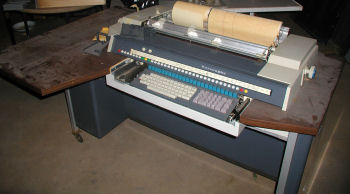
This is a Burroughs computer. It is a bit of a missing link between the electric typewriters of yesteryear, and the computers of today. These aren't exactly common machines, and I honestly wouldn't know what to do with it if I had one. There should be a bar fridge sized box that the typewriter part connected to somewhere, but I didn't spot it on the day. 

Here's a photo I found of a Burroughs computer not buried behind a mountain of junk.

A later model of the same machine that had been integrated into a desk.  (from vintagecomputer.net)

The Burroughs at this store sat in an integrated steel desk that was painted an industrial looking blue. The keyboard was flanked by wood similar to the machine depicted above, but wasn't so elaborate. I'd seen such machines before at La Trobe University in Melboune in the 80's, and even then they were relics that were more curiosities than teaching aids in the uni's computer lab.

So I moved on from this machine, and soon found myself face to face with something I had never seen before in anyone's collection. Ted's typewriter database has a category for this machine, but nil information on it. In fact, after considerable effort I have only found tiny pieces of information thus far on this typewriter. 

Meet the Stott  model L1

 Please ignore the toy snake on the top. That seems to be there simply to guard the machine from people wanting to actually.... type.

Priced at $120 (probably negotiable) this standard looked impressive but still pricey. I might have even made an offer for it, but sadly I had no room left in the car. I considered getting Steve to sit on top of the machine for the rest of the trip. It was made with a thick shell that could take a hit from a rifle and survive, so I'm sure it would have been safe under Steve. However it would have made for an uncomfortable couple of hours. 

However it had me scratching my head. The Stott name was familiar, but this typewriter sure wasn't. There were design features on  this machine that I  had never seen before. The space-bar was carried over the shell of the typewriter with the he ribbon cover slotting down into the same shell. The corrugations on the façade also was very foreign. 

It sort of... looked... similar-ish to an Adler universal, but it wasn't. Part of the machine reminded me of earlier Olympia desk-tops, while the keyboard was closer to the Adler's design - but substantially different enough to strongly doubt that it was from the same manufacturer. Confusingly it has the fawn and beige colour-scheme of the 50's era Grundig made Triumphs.

 I just can't place this machine with absolute certainty. 

So what is it?

Well, it is a re-branding of some kind, but whatever it is, it has been significantly changed from the base machine that it came from. Even the carriage set-up and platen knobs don't match anything that I googled a look at.

What I can tell you is that the machine was sold by Australian company Stott & Underwood. Rob Messenger did a significant write-up on the history of Stott some time back, but didn't mention any machines made specifically for the company. At the end of his article he had exhausted himself before he exhausted his material so there may still be something. 

How do I know this? I found an advertisement for this machine.


Stott placed a large advertisement in both 'The Age' newspaper in Melbourne, and the 'Sydney Morning Herald'. It was placed by a company called 'Stott Equipment', but the advertisement in The Age showed the company as actually being located at the 'Stott Underwood' offices in most of the major Australian cities. see the bottom of the advertisement below.


These advertisements appeared in both of these newspapers, on page 3 no less, on the 8th of April 1969. So I think we can confidently place these machines as being manfactured around this time (Ted, want to update your Stott section of your database?). 

This was 3 months after Litton had just purchased Adler and Triumph of Grundig. No major structural changes had been done to the company by this stage, and Litton weren't using Adler's design to produce a variety desktops yet. .Adler and Triumph were certainly still producing machines in Germany.

Underwood however were part of Olivetti, and Olivetti was at the time a very strong brand. However Royal, a manufacturer that Litton already did own along with Imperial, were pretty much considered near dead. 

On the same day Stott advertised this machine, Adler proudly placed a similar sized ad one page over marketing  their newest machine. It is an electrical beast that I have still to lay eyes on personally. 


The Stott disappeared from view in the newspapers almost immediately, and there's no other reference to this machine to be found in the papers of the time. The company that sold it had at the time only just been sold to another company, and was re-structuring to become which is now known as the Stott business college in Melbourne.

The machine seems closest to the Adler designs of the time, however it is far from certain that they manufactured this machine. The origin of the machine still alludes me, and I think it had a very short life during a tumultuous business period.  So what do you think? 

Steve and I loaded back into Ruby for the last stretch of road back to Melbourne. Our journey was about to come to a close.

Wednesday, 7 May 2014

Politics and typewriters in the halls of power.

 
Rob in front of the 'red zone'


.... Sometime in the 1980's.

The phone was hung up with a slam rather than a gentle hanging up. It was a 70's era wall-phone and the give in the plastic immediately bounced the handset back out of the cradle.

"Keating is a f***ing prat. He's more right-wing than f***ing Fraser was".

My mother had quite a way with words. The Keating that she was talking about was the then federal treasurer Paul Keating who she was lobbying for funding for disabled services. Before she developed Multiple Sclerosis my mother was ferociously passionate about politics and social justice, and a champion swearer. Both characteristics that she passed on to me, however that's a story for another blog entry.

After she developed MS, she was just the same, but a lot more focused. Comparing Keating to former Prime Minister Malcolm Fraser was, for members of the Australian Labor Party like her, an extreme insult. Keating would eventually become Prime Minister of Australia and my mother's campaigning would one day be part of the foundation of what was to eventually become the 'National Disability Insurance Scheme'.

Later, my mother would proudly hang a letter of thanks from Keating (by then the prime minister of Australia) on the wall next to her recliner. As if to put Keating in his place, his letter was over-shadowed by another frame above his the contained a thank-you from Nelson Mandela.

My mother was ferocious when it came to politics. She was loaded to the hilt with insecurities (just like me), but in debate she could verbally rip people apart.

My sister and I were in training from a very early stage in the art of politics. My parent taught my primary school aged sister and myself how to campaign against a new rule the school had brought in that required kids to spend one lunch time a week cleaning up rubbish from the school yard. We petitioned the school with signatures from other students that had barely learned to write their name, and we'd brewed up unrest amongst the students. Soon something that started out as an exercise in learning about politics came dangerously close to having a real impact. The school attempted to ban the petition, but my sister and my 11 year old self asserted our civil liberties and soon parents were questioning the administration why their kids were being used as garbage collectors.

A school council meeting was organised, and my parents were summoned. My father was part of that council which made things interesting, and by the end of the evening certain provisions were offered in lieu of cessation of the petition. I got a lesson in the complexities of politics, and the school was able to go back to teaching kids how to care and be responsible for their environment.

Thursday, 1 May 2014

Alternative keyboards?

It seems Microsoft have come up with something cool to do with a keyboard. This... cool thing.. is a merging of computer system controller and.... a keyboard.

So someone down here in the Australian media has then seen it and which somehow led to them writing an article about alternative keyboards. 

The device itself is actually more about replacing the trackpad or mouse, but the writer certainly didn't let that fact get in the way of a good story about keyboards. And while the article provides nil new information, it does however talk a fair bit about typewriters and the history of attempts to change the keyboard.

You can read the article here. But don't just yet.

Don't spend too much time reading the article. The author doesn't actually "say" much. Instead, they seem to have liberally quoted Rob Messenger over at Oz Typewriter for the article, and looked at the already pointles KALQ keyboard.

Now my question is: Rob, (or anyone else) do you actually have a DVORAK  keyboard typewriter? I'd love to get my hands on one, or at least see one.

In the meantime while we're waiting for these replacement keyboards, here's a picture of what Time magazine calls 'the ultimate blogger desk'. A desk that has been made so your cat can scurry about exploring inside instead of annoying you on the top of your desk.

Meow, n' stuff.

I need to get me one of these to replace the 1920's dining table that I currently use as a desk. I might also need to get a cat as well, but I don't think that'll be hard to find. But I can't see this desk ever replacing the standard QWERTY desk. 

Although, if it is able to keep the cat off the top of the desk, it may keep it away from the "Robotic Printer" that is going to replace our regular printers.

Yeah, Shark-cat. You know it. Get back in your desk and off your robot.

Hmmm... I'm sure there's some more useless garbage that I can cram into this post. Just let me know if I've missed something.

Monday, 28 April 2014

Surprises? I like surprises....

So... I'm back in Brisbane. 

I've been back a few days, and while this isn't a bad thing I'm feeling a little sad about it. Quite sad. 

But not too sad. There seems to have been a steady flow of little surprises of late. 

The Typewriters. 

Let's get down to business. Firstly, I managed to score a beautiful little Remington portable 2 that needs a little bit of mechanical attention, but will be a gorgeous little machine once I've got it going again. The colour was a surprise. Not only was it different to the photo on ebay, but I've never seen a Remington machine... ever... of this colour. However, it does have all the original Remington decals, and is suitably worn so I'm supremely confident that this is the original colour. 


I'm really excited about the potential of this machine. With a clean and a bit of hard work, I think it will be brilliant. 

Following hot on the heels of the Remington, is a machine that I've been excitedly waiting for, for some time. It has travelled a LONG way, and is a cracker of a machine - even if it is more modern then the machines I usually like. I have never seen one of those in Australia, or for that matter in the USA. It is the direct decedent of the Triumph Perfekt, and is a far more interesting machine in person than it is in the photos. 

May I present.... The Gabrielle - E 


better photos an a full review to come soon. 

Oh, and thanks a heap, Spider

To top it all off, a third machine came into my possession in the last couple of days. This one is a little more mundane, but there's something a bit special that came with it. 


It is an Olympia SM9, which there's got to be about a billion of these guys out there. Sure, it is far from rare. But it has only had one owner (now, I'm it's second) since the day it was bought. As you can see, the original receipt is there along with everything else. The lady that owned it kept everything meticulously organised. 


So we have the manual, a touch-typing guide that was produced by the Australian government's bank - the then 'Commonwealth banking corporation'. A test sheet that shows the typewriter's typeface is all in order, and there's the SM9 quick setup guide. 

But the receipt told a little story of it's own. This machine was bought somewhere very interesting. 


See which shop it was sold at, for $115, in 1971? 

That's Madang, Papua New Guinea. 


PNG was in a state of flux in 1971. It was a country that was coming back from being a major theatre of war during the second world war, and was forming its own government. Australia's own government assisted in the building of the nation, and we sent hundreds of bureaucrats to assist. Not only that, but hundreds of missionaries poured into the country to lay claim to the souls of thousands of tribal people that were still to have contact with the outside world. 

And here we have a then brand-new Olympia SM9 being sold to someone out of a shop in a fairly remote town in PNG. 

Parer's war. 

Speaking of PNG. Rob Messenger mentioned on his blog a couple of weeks ago a film that was going to be aired on Australian television called 'Parer's war'. I was rather eager to watch it, so I settled down with a cold drink and sat back and watched - with a bit of an eye out for typewriters that may pop up. Why not do a bit of typewriter spotting, you may say! 

But some of the interior shots of Parer's home seemed oddly familiar. And towards the end of the film I got an unexpected shock. 

The outside of 'Parer's' block of flats (apartments). 

Such a beautiful art deco building it is, right? 

The courtyard in the front of the building. 

That's also quite a beautiful court-yard. I wish I lived somewhere like that. 

Oh wait.... I did. Actually, when I started writing this blog in 2012 I was still living there. Remember my blog entry on the cinema nights I used to run in that courtyard? 

'Cinema Elron' 


Yeah... That Elron Court. 


The interior shots weren't filmed in Jane and I's old flat, but rather the flat that was opposite us across the garden at Unit 1. 


A good friend of mine used to live in that apartment, and I'd have to have spent hundreds of hours there drinking lovely wine and talking politics, religion and sex. All the stuff you don't talk about in polite company. 


Heck, when she was away I would go over and feed her birds, which were kept in the room that in this scene is being done up for a baby's nursery. Even the phone jack on the wall where her computer used to be connected is visible in this scene. 

Lovely! 

I did a fair amount of research into the history of the building when I lived there for 5 years (Jane lived there 11). It was built in 1939, and opened for tenants in 1940. 


But I have no idea if Parer himself actually lived there at any stage. There are a lot of interesting stories to be told about that place, and it was nice to have added history of my own to it's tale. 

Ahhhhh.... I'm getting all nostalgic again. I better get back to packing house, as I'm moving again very soon. 

Thanks for reading! 

Thursday, 24 April 2014

Sydney Typosphere, Where the bloody hell are ya? (and your typewriters)

Steve and I woke up early again as we were eager to get into Sydney and through the traffic before it became difficult to drive on it's consistently grid-locked roads. It was a cold morning in Scone, and my car was frosted from cold condensation that had dropped overnight as it hit the nearly 30 degree mark. 

I looked out across the road as a coal train snaked its way past the town about 500 meters from the hotel. I felt this seemed particularly odd as it was an Easter Sunday. But I guess the mining industry stops for no one, not even the religious. I'd see several more such trains travelling beside the road before the day was out. 

Coal shipping in Scone. 

We jumped back into Ruby the Exxy, and immediately there was something wrong. The 'battery' light - which is actually the alternator warning light, was on and was staying on. I found a servo to get some petrol, and started to try and assess what was wrong once the engine was warm. 

With a couple of blasts of WD40 and a little bit of testing I determined that the alternator was able to produce a healthy charge,  so Steve and I thought we'd just try our luck and see how far we went. I had roadside assistance coverage, so if we did get stuck we'd be able to call for help. As long as we had phone range. 

After about 20 minutes there was a loud squeal and a thump, and the alternator light turned off. From that point onwards Ruby drove just as well as she always had. WD40 may have saved the day. 

Maybe. 

We grabbed breakfast on the road and just kept on driving. It wasn't long before we hit a brand new dual carriageway that turned the highway to Sydney into a Freeway, and we were soon barreling across the landscape at an uninhibited 110km/h. This was a bit of a shame really, as this new road bypassed many of the most beautiful towns to be found in the Hunter Valley. Instead we ended up having an effortless drive into Australia's largest metropolis - the crazy emerald city of OZ. Sydney. 

Now, I'll liberally steal from a somewhat failed Australian Tourism commercial when I ask this question: Sydney Typosphere, where the bloody-hell are ya? 

Sydney according to Apple Maps. 

Sydney's population is 4.6 million. Melbourne's population is 4.2 million. Brisbane's is 2.2 million (all as of 2011 census). My blog gets several readers from Melbourne, and my blog on Tom's Typewriter shop constantly gets hits by Victorians checking out information on his shop. So while there's really only one consistent blogger (see Teeritz Agenda) There's plenty of users down in Melbourne. 

Brisbane also is quite the same. I get a fair few general readers from Brisbane, and as we've seen there's quite a few lively bloggers there too.

Even Darwin and Perth have bloggers. People from Adelaide frequently email me, and they make up a fair amount of the buying and selling activity on ebay. And of course there's Canberra - which despite it's diminutive size, appears to be the typewriter writer capital of Australia. I have several consistent readers from Canberra, and not talking about just Rob and Jasper either.

But Sydney? I know of a guy that services machines there, and I know of at least one collector. But Sydney is incredibly quiet. Vanessa Berry, who is listed up in the Typosphere as a blogger is very Zine focused, and I've personally never seen her interact with other typewriter lovers. In short, typewriters and the typosphere in Sydney seem to be practically invisible. 

My blog also features nil interaction with people from Sydney. No readers, no commenters, nothing. Discussions in forums about hunting typewriters in Sydney often lead to nothing - as though the place is a veritable black hole. I often see machines being put up for sale there on ebay or gumtree, but there's more in outer New South Wales than there seems to be in that state's capital.

It puzzles me. With the level of creative activity going on in Sydney, and the size of its population you'd kinda expect to see more writers using their machines and collecting them there. But instead it is a dark patch of sky with only a few stars dimly twinkling. 

As it was Easter Sunday when we arrived in Sydney few shops were open. Steve and I didn't take the opportunity to hunt for typewriters, and instead headed for the Sydney harbor bridge - often known as 'the coat-hanger'. I popped open Ruby's roof and stuck the camera out as we crossed the bridge in the hope of getting some shots. They worked out okay, and both Steve and I had fun as we drove across this rather famous Australian landmark. 


As we drove into the CBD we found ourselves somewhat lost. After doing a few circles we came across a road that was completely shut off from traffic. On that road a large group of people stood waiting and watching the hotel across from them. They were being held back by a temporary steel barrier and a host of Australian Federal Police officers who were controlling the affair. 

These people were here to catch a glimpse of the visiting royals. A sign that Sydney does still hold onto some archaic and anachronistic traditions. 

Steve and I ducked around the miasma and headed out towards the western suburbs. Ruby showed no sign of failing, so we looked at the map and headed to Canberra and the Australian Typewriter Museum at Rob Messenger's place. 

Not a typewriter or typewriter lover was to be found in Sydney. If you're reading this and you live there, give me yell as I'd love to see that there's signs of life.

Steve Snow's blog, The Impatient Typewriter Mechanic' can be fond  HERE

Tuesday, 22 April 2014

Pushing the New England


My alarm went off at 3:30 am, and I immediately sprang to my feet (I'm a morning person, clearly). By 4:20 I was on the road to Steve Snow's place, and by 5am I had his company with me while I drove Ruby the Exxy. It was a cold easter Saturday morning, and we would see another car on the road roughly every 20 minutes until we finally rolled onto the New England highway. 

The New England is another of 3 alternative routes between Brisbane and Melbourne. And one of two that passes through Sydney. It is also called New England for a very good reason. The route passes a long series of pastures and towns that have retained their very british pastoralist roots. Many european trees dot the route, and the landscape often feels like the rolling hills off what many of the earlier Australians called 'Home'.

Past the town of Ipswich we began to drive through some quite thick sections of fog. With a quick flick of a switch, Ruby's fog lights powered on, and we then happily continued to drive along the highway as the sun started to rise over our left shoulders. 

The fog shifted aside, and we soon found ourselves driving up the Great Dividing Range as the sun hit the mountains with a beautiful Orange glow. The view was incredible as we looked along the tinted mountain range, but sadly couldn't find a spot to stop and take a photograph. 

We grabbed some breakfast in Steve's home town of Warwick, and we were quickly back on our away again. 


We rolled into a couple of towns and found that we were either too early for their second hand and antique stores to be open, or in some cases too late - as Google seemed to insist that some stores that had been closed for years were still open. 

Sadly, many of the towns along the New England feel like ghostly shells of their former glory. Hints of how life was in days that have passed, and relics of the means and methods of trade and business that once drove the economy in these rural areas still survive but are sadly crumbling as people drive past them. There's both a vibrance and sadness about the fading history along these highways that many travelers miss in our contemporary era.   


The safari begins in ernest...

In my car I already had 7 typewriters. These were machines that I either couldn't pack into boxes due to the oversized nature of their cases, or the fact that they were standards that were also way oversized and had carriages that couldn't be removed. 

These were machines that I wouldn't trust with removalists, so I decided that while I'm taking the car down to Melbourne, these may as well come with me along with the car-load of stuff that I had packed for Miss Jane

It wasn't until we hit Armidale that we saw our first machine. It was a lowly Adler 'Tippa' - for want of a better name. This machine in comparison to my earlier model Tippa typewriters was awful to type on. It was in great condition however, and I was somewhat surprised to find that it's shell was metal. It was even at a great price of $15. However both Steve and I decided to throw this fish back in, and let it go to another owner. It wasn't even worth my effort to buy and re-sell on ebay, as it wouldn't get more than $30 or so dollars. 


We hopped back into Ruby and quickly headed out of town. It wasn't long until we came across a smaller town that had a disproportionate amount of second-hand or antique shops. The very first shop we came across bore hunting success before we even got out of the car. As Steve pulled Ruby into a parking spot in front of the shop, we came face to face with a familiar sight - a Remington 17 perched immediately in front of our car. 


I asked the woman in the store how much she wanted for it, and she gave me a surprised look before shrugging her shoulders and saying 'aww...... fifty bucks'. The tone was rhetorical, which told me she was clearly open to negotiation. I thought I could press the point and get the machine for $30, but I simply felt that I had too many machines in the car as it was, and the condition of the machine wasn't that amazing that I felt compelled to buy it and rearrange the car to fit it in. 

So we left this beast to the next buyer, and shuffled into the workshop next door to check out what else was happening. Here we found an array of car parts and old tools for sale, as well as a fully-functioning hot-rod restoration workshop. 


Futher down the road we found two more shops. However, these places sadly yeilded no fruit.


The city of Tamworth was a bust, but we did get an excellent lunch there. Steve however discovered that a fully-loaded X-Trail is oddly hard to parallel park, and as such parked my car about a meter from the curb. The Exxy is by no means a 'big car', and as such it still didn't exactly stick out over the road. 

Tamworth is the self-appointed capital of country music in Australia, and you can see this in almost every nook and cranny of the place. Country music is worshipped so much in this place that they've constructed a giant golden guitar on the road into the town that confronts everyone coming up from Sydney. It is so bad that whenever I book a hotel there, I can't book it by my last name as it invariably leads to lengthy questioning about my somewhat famous country music relatives. Usually Tamworth had been an end-point on a drive for me, and this was only the second time I had driven through it either two or from Brisbane. 

I'll just stress that I'm in no way a fan of country music. So dear readers, don't start getting an image of me walking around in cowboy boots and an Akubra hat, while listening to some melancholic twang. 

So we drove on and enjoyed a lovely piece of the Australian countryside. It had rained a fair bit recently, and everything looked kind of fresh and clean. 

A bit north of the town of Scone we turned off the highway at a second-hand shop that I'd visited in the past. It had previously gotten some great deals on some stuff here, and it is a must-stop part of the journey. 


Steve and I got down to the business of looking for typewriters, and Steve within minutes spotted an Olivetti Linea that was in awful condition. Flanking this machine was a dusty electrical of some kind. They were on a high shelf and out of reach, and by the time I got down to that end of the shop Steve was busy trying to find something that would get him up there to have a look at these machines.


I looked further along the same shelf near these machines, and noticed some familiar looking boxes and vinyl covers. I pointed them out to Steve and said 'Those are going to be of much more interest to us'. Steve agreed and then excitedly ran off to find the shop-keeper to get a ladder. 


I spotted a small black case that I thought would be specifically of interest, and there was a brown case that I immediately thought to myself 'That looks familiar, I wonder what it is'. 

But despite my enthusiasm for the first case, it turned out to be a rather dull looking Lamir that came with a $27 price tag. I photographed it for the record, and looked at Steve who also declined it. 


With a $17 price tag however, the brown box turned out to be a very familiar Remington Quiet-riter. 


Another familiar case grabbed my attention, and I needed no prompting to know what machine was inside. It was unmistakably an Imperial Good Companion 4. It has a price tag of $37, and was extremely dusty. Inside the machine looked dull, chipped and stained. But I ran a thumb lightly across the surface, and what I thought were chips in the paint turned out to be just debris that had blown into the case. As I rubbed a near perfect IGC started to shine out at me from beneath the deceiving detritus. This machine was actually in incredible condition. 


Steve declined on both the IGC and the Quiet-riter, and left it to me. I made an offer of $30 for the IGC, and the seller accepted. I then made an offer of $15 for the Quiet-riter. He thought a little, then also accepted that. With a promise of a dusting, they were mine.

On a side note. In the last 2 weeks I'd just sold an IGC4 and Quiet-riter. There's a real irony to the machines that I moved to get rid off from collection seem to in some way or another find their way back. Both of these machines are in better condition than the ones I sold, even though the Quiet-riter's case probably needs a re-covering. 

There were some other interesting machines to be found there too. They had a Smith-Corona electric machine of a more modern era, which we didn't even bother bringing down from the shelf. A remington SJ with and interesting Bakelite facia that I've only come across a few times in the past - complete with Remington Super-riter Vinyl cover. 

But I think I got the most interesting machines that were available from that batch. 

When I went to pay for the two machines, the guy at the counter had not only dusted the cases off, but had wrapped them in garbage bags so that no further muck spread about my car. I found that incredibly thoughtful and considerate. I gleefully handed over my dosh, and took my typewriters and found a spot for them in the back of Ruby. 

No sooner had I closed the back of the car and reversed out onto the highway Steve and I found ourselves rolling into our destination for the evening - the town of Scone. 


The lady on the front counter at the Isis hotel greeted me with one of the warmest smiles I've ever been given at a hotel, and she soon had us organized with a room. I quite liked the Isis hotel, and I'd recommend it to anyone.


 As I got settled into the room I started to smell a wood fire getting started. The hotel cooks pizza in this wood fire, but Steve and I headed into town on foot where we grabbed a pizza there, which we ate in somewhat deserted, but historic pub that was being run by a very lovely and enthusiastic woman by the name of Sarah. 

We had a few beers and talked travel with our host before we bid her farewell and left her with her boyfriend to close up the old pub. With full bellies and a satisfied feeling we walked back to the room and hit the hay ready for our next day's driving through Sydney to Canberra.